PROMETHEVS
Promoting Universal Values through Digital Epigraphy and Cultural Heritage
Welcome to the PROMETHEUS Digital Collection of Inscriptions and Stories! Explore our selection of Ancient Greek and Latin epigraphic monuments from the Republic of North Macedonia, the Republic of Serbia, and the Republic of Bulgaria to learn how people lived during the Roman Imperial period. Discover how they loved and grieved, what they feared and strived for, and what they believed in and hoped for. The PROMETHEUS Digital Collection of Inscriptions and Stories is the result of the project PROMETHEUS — Promoting Universal Values through Digital Epigraphy and Cultural Heritage, co-funded by the European Union’s Creative Europe program (Culture strand), the Ministry of Culture and Tourism of the Republic of North Macedonia, the Ministry of Culture of the Republic of Bulgaria, the Ministry of Culture and Information of the Republic of Serbia, and the project’s partners. To browse the inscriptions and stories by specific criteria, use the Filters and Indices menus. For additional information about the inscriptions, their content, and available resources on epigraphy, classical studies, teaching materials, and digital tools, consult our Manual.

Αbout the project
PROMETHEUS — Promoting universal human values through digital epigraphy and cultural heritage is a small cooperation project co-funded by the EU programme “Creative Europe”, Culture strand. It is also co-funded by the Ministry of Culture and Tourism of the Republic of North Macedonia, the Ministry of Culture and Information of the Republic of Serbia, and the Ministry of Culture of the Republic of Bulgaria, as well as by the project partners. The project duration is 2 years (2024–2025). The project consortium includes 5 institutions from 3 countries: North Macedonia, Bulgaria, and Serbia. The project coordinator is the Archaeological Museum of the Republic of North Macedonia in Skopje, and the remaining partners are the Faculty of Philosophy of the University of Belgrade, the Institute for Balkan Studies of the Serbian Academy of Sciences and Arts, Sofia University “St. Kliment Ohridski”, and Ss. Cyril and Methodius University in Skopje. Project activities are divided into five work packages (WPs): 1) Management, administration and coordination; 2) Capacity building; 3) Networking and knowledge sharing; 4) Digitisation of epigraphic monuments; 5) Communication and dissemination.
Epigraphic monuments are an important part of cultural heritage and a valuable source of information about the past. They bear witness to all aspects of human civilisation and provide essential evidence about everyday life, public institutions, politics, and culture. More than any other written historical sources, inscriptions are personal diaries. They record love, loss, sorrow, hope, faith, well-being, honour, pride, respect, success, power and authority, freedom, peace, and war. Thus, they are a reliable means for recognising and promoting universal human values. The countries of South-Eastern Europe and the Balkans possess substantial epigraphic heritage from the Greco-Roman period, reflecting the life, culture, and history of local peoples and their relationships with the civilisations of ancient Greece and ancient Rome. Inscriptions tell, in their own specific way, stories of inclusion and diversity and can help us better understand these issues in the context of universal human values. The current war in Ukraine and its consequences for Europe and the rest of the world once again remind us that sustaining humanity is an obligation of every generation. Epigraphic heritage has the potential to teach audiences—especially younger generations—about the importance of this obligation.
Over recent decades, epigraphy has undergone a significant evolution as a digital field of research. Various digital corpora of inscriptions meeting the highest scholarly standards have been created. Numerous initiatives have been launched to promote the use of digital technologies for presenting the content of epigraphic monuments to wider audiences, encouraging the study of Greek and Latin, and popularising knowledge of history and culture.
Even so, existing digital models for presenting museum collections and archaeological sites still hesitate to take full advantage of the written content of inscriptions in order to actively engage the public. Digital publication of inscriptions in South-Eastern European and Balkan countries remains weakly developed. Museums in general need models for attracting new publics and engaging them in perceiving and experiencing cultural heritage through digital epigraphy. International cooperation among cultural institutions in the countries of the region needs to be deepened.
The aim of the cooperation between the Archaeological Museum of the Republic of North Macedonia and Ss. Cyril and Methodius University, Skopje, Republic of North Macedonia; Sofia University “St. Kliment Ohridski” (Faculty of Classical and Modern Philology), Sofia, Republic of Bulgaria; the Institute for Balkan Studies of SASA; and the Faculty of Philosophy of the University of Belgrade, Belgrade, Republic of Serbia, is to combine established successful practices in the digital edition of inscriptions and in the application of epigraphy as an educational tool, with a view to actively engaging different publics and popularising epigraphic heritage based on promoting universal human values.
The present project stimulates transnational creativity and circulation, enhancing the capacity of cultural institutions for innovation and development. A core focus of its activities is improving access to and interaction with culture for different categories of audiences, as well as engaging and increasing audiences in both physical and digital environments. The activities also concentrate on capacity building, training, professional development, and digitisation.
To achieve these goals, cooperation among South-Eastern European and Balkan countries and other European states focuses on creating a digital collection of ancient Greek and Latin epigraphic monuments from the territories of North Macedonia, Serbia, and Bulgaria, accompanied by appropriate digital resources for use by expert and non-expert audiences. This cooperation supports the free exchange of experience, good practices, and knowledge in the field of digital epigraphy and the presentation and popularisation of epigraphic heritage among institutions involved in various aspects of safeguarding and managing cultural heritage. It builds the capacity of museums, archaeological sites, and educational institutions to digitise and document epigraphic monuments and to create and develop their own digital corpora of inscriptions. Even more importantly, it helps them explore possibilities for implementing existing and creating and developing new models for encoding and electronic publication of inscriptions that engage broader audiences in ways enabling everyone to recognise human values as a link between past, present, and future—a link connecting people regardless of gender, race, religion, language, or nationality. The project also builds the capacity of these institutions to present local epigraphic monuments and the cultural heritage of classical antiquity in a way that allows everyone to recognise them as part of the European cultural space.
Ultimately, the project strengthens the capacity of cultural institutions to work more closely with schools and universities and to organise events and activities in which learners will have the opportunity to apply their digital skills, value cultural heritage, and at the same time study Greek and Latin, epigraphy, and history; to learn more about the Greco-Roman roots of European civilisation and modern culture; and to develop their ability to analyse issues related to diversity, inclusion, gender equality, and the environment from a diachronic perspective and from the perspective of universal human values.
The project results are digital and open access, available for application by cultural, educational, and research institutions, as well as by diverse audiences worldwide.
See our User Tutorial here:
News
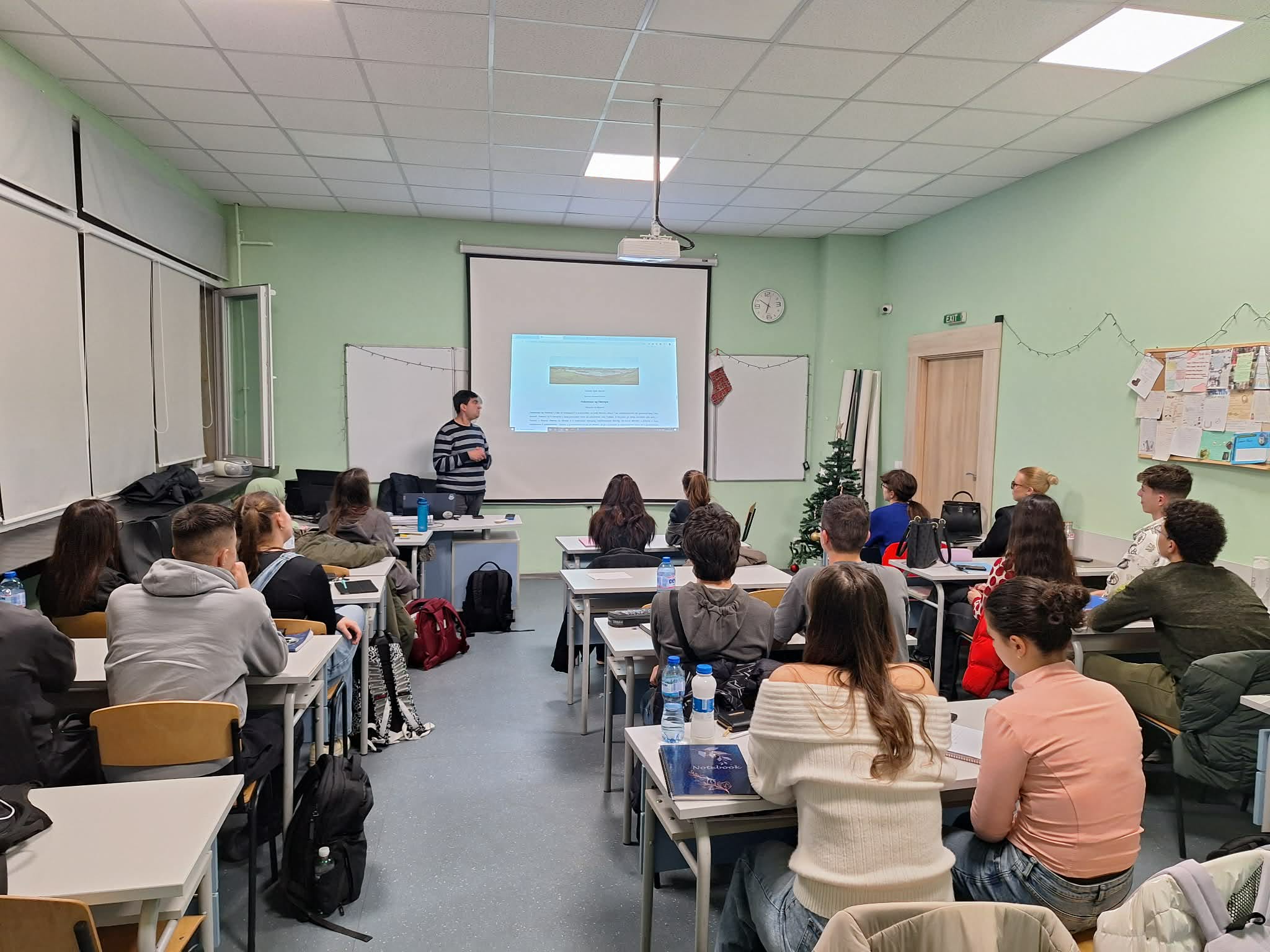
Prometheus in the Classroom - Sofia!
Published on 29.12.2025 by
 Back on the 11th of December, 2025, the PROMETHEUS team from Sofia University “St. Kliment Ohridski” held an engaging workshop with 10th-grade students (History and Geography profile) at the National Gymnasium of Natural Sciences and Mathematics “Acad. Lyubomir Chakalov”.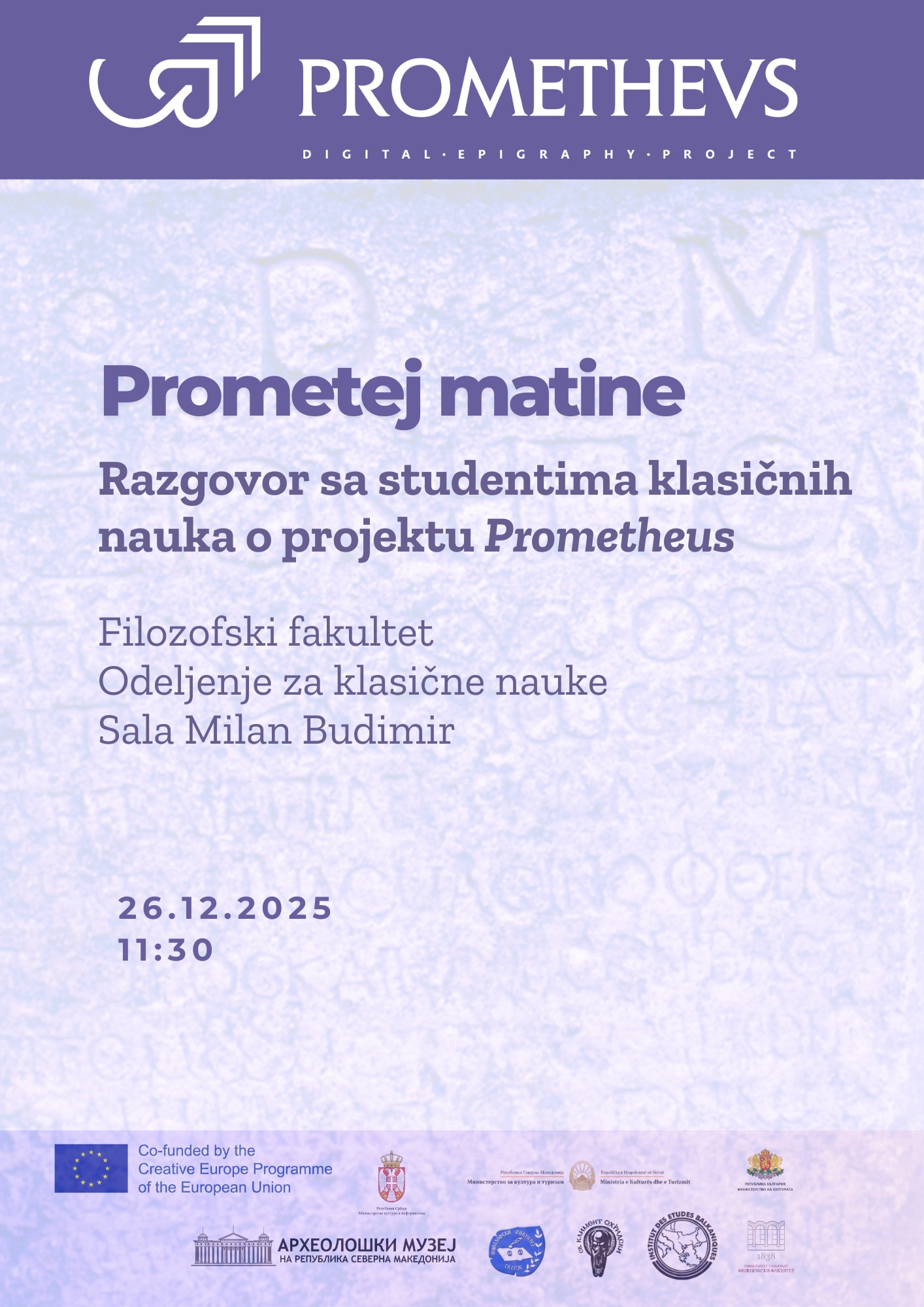
Prometheus matinee: A conversation with Students of Classics
Published on 28.12.2025 by
 On 26 December 2025, the PROMETHEUS Project hosted Prometheus Matinee, a special event bringing together students of Classical Studies for a discussion about the project. The matinée took place at the Faculty of Philosophy, University of Belgrade, at the Department of Classical Studies, in the Milan Budimir Hall.
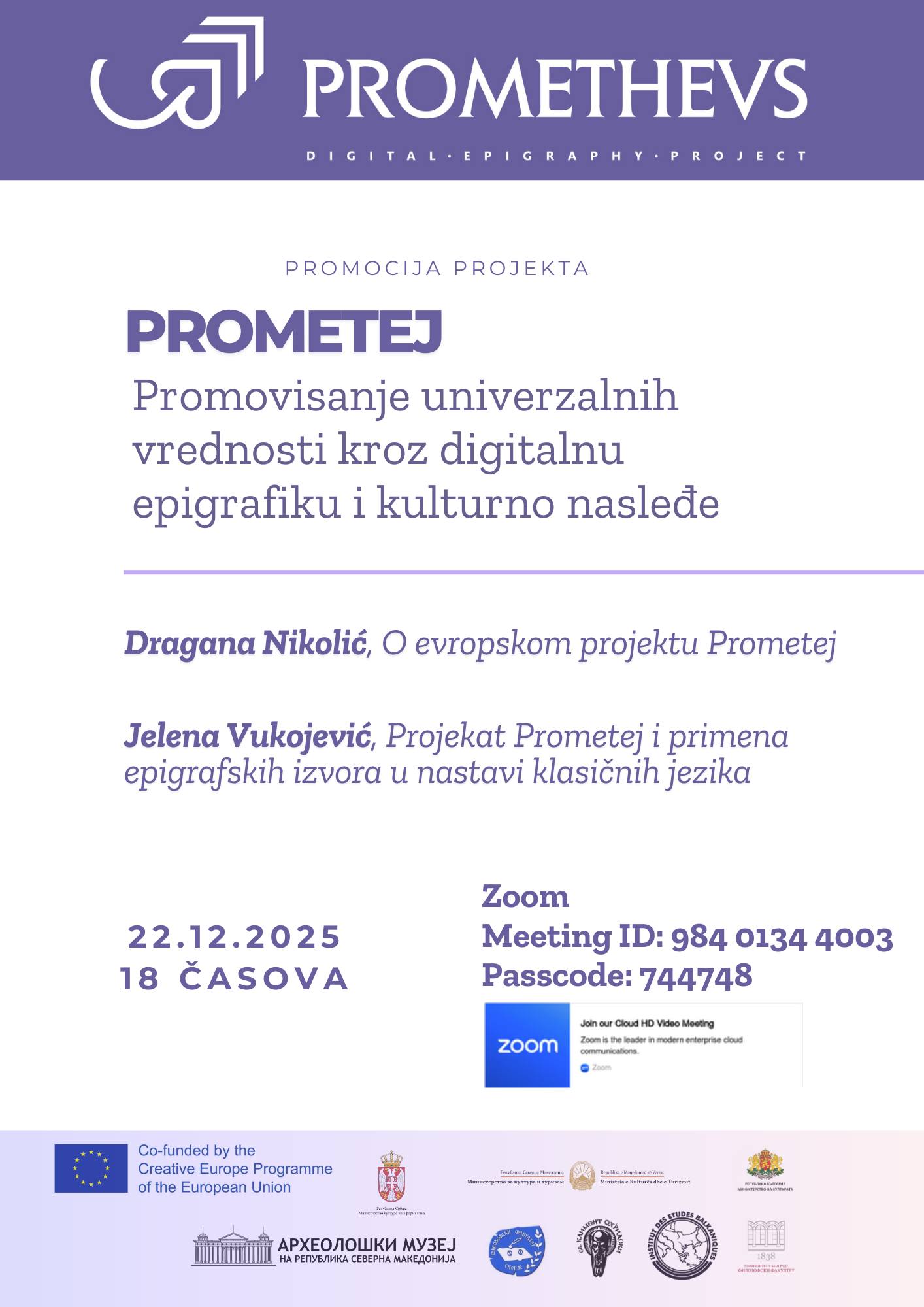
Prometheus Online Dissemination event in Belgrade!
Published on 23.12.2025 by
On 22 December, the PROMETHEUS Project hosted an online dissemination event in Belgrade, primarily aimed at teachers of classical languages. The event was structured in two complementary parts and focused on presenting the project’s outcomes and their practical application in teaching.
Stories
Stories inspired by ancient monuments and inscriptions. Immersing us in the spirit of the era, revealing the experiences of the author and the heroes from the inscriptions.
Learn more.jpg)
Monuments
Ancient monuments studied over many years by our international team. Deciphered and encoded for better machine processing and presentation.
Learn more
Indexes
Collected and categorized during the process of deciphering inscriptions. Common elements with additional information that assist in the study of monuments.
Learn moreLast added stories
Legend of the City of Victory
Look at this monument, dear, and ask who’s the person who built it; O, Hermogenes it was, who was grieving for me and our daughter, Thecla, the curly-haired girl who was taken by Fate with no mercy. Pure she was, for indeed she had never laid with a husband, God, please accept her like this, unblemished by passion or marriage. Now let me tell you the names of the two other people that rest here. It is my brave little boy who was known by the name Demosthenes, Son of Matrona – that’s me, and I live in the city of Nike. Fourth in the grave, by his son, the father and husband was laid down.
Learn storyRelated monuments

Funerary inscription of the family of Matrona from Nicopolis ad Nestum
Editors: Georgi Mihailov,Repository: Regional History Museum - Blagoevgrad,
Preview: Δέρκεο σῆμα, φέριστε, καὶ εἴρεο τίς κάμε τοῦτο. Ἑρμογένης ποθέων...,
Type: slab,
Material: marble,
A summer afternoon in Augusta Trajana
A summer afternoon in Augusta Trajana. It’s hot and there aren’t many people around; just a few can be spotted hiding from the scorching rays of the July sun behind the columns of the stoa. It is quiet, even in front of the temple. Two boys, not older than sixteen, come out of the gymnasium – they have just finished their classes. They are obviously in no rush at all.
Learn storyRelated monuments
Honorary inscription for Marcus Ulpius Genialis from Stara Zagora
Editors: Gawril Kazarow, Georgi Mihailov, Nicolay Sharankov,Repository: Stara Zagora Historical Museum,
Preview: Ἀγαθῆι τύχηι. κατὰ τὸ δόγμα τῆς σεμνο τάτης Λακεδαιμονίων πό...,
Type: statue base,
Material: marble,
The starlet of Kamenovo
Maiden of youth that was laid in the grave with her dearest mother; Twelve years old when I was, an illness took over my body. Now in a grave with my mum, I, Secunda, am quietly resting; But Aphrodite has turned me in a glowing and beautiful starlet. Fortune to all! Who wouldn’t be touched by such a grievous inscription? 1800 years ago, a young girl’s family had an altar built in her memory. They probably visited it often, to commemorate her. They would leave food, wine and gifts, same as we do today in Bulgaria, on All Souls’ Day.
Learn storyRelated monuments
Funerary inscription for Secunda from Kamenovo
Editors: Georgi Mihailov,Repository: National Archaeological Institute with Museum,
Preview: Ἀδμὴς παρθένος εἰμί, φίλῃ δ’ ἅμα μητρὶ τέθαμ μαι ∙...,
Type: altar,
Material: limestone,
The Voice of Prima
To have a sister that was turned into a starlet by Aphrodite, the goddess, sounds like a fabulous perk. While the rest of the family argue who will inherit the orchard, you can simply point to the sky and say: ‘I have a sister among the stars! I need nothing else.’
Learn storyRelated monuments
Funerary inscription for Secunda from Kamenovo
Editors: Georgi Mihailov,Repository: National Archaeological Institute with Museum,
Preview: Ἀδμὴς παρθένος εἰμί, φίλῃ δ’ ἅμα μητρὶ τέθαμ μαι ∙...,
Type: altar,
Material: limestone,
Versifying sorrow
Do you know what a cento poem is? Have you ever read one or tried to write one? The Latin word cento means “patched cloth,” and the same idea in Ancient Greek was expressed by the word κέντρων. Both terms were also used to describe verses composed of scraps from other authors.
Learn storyRelated monuments
Funerary inscription for Eugenius from Suvodol
Editors: France Mesesnel, Nikola Vulić, Werner Peek, Anne-Marie Vérilhac, Joachim Ebert, Nicolay Sharankov,Repository: Archaeological Museum of the Republic of North Macedonia,
Preview: κέκλυθι, τέκνον έμόν, καὶ ἀνά στεο σοῖσι γονεῦσιν· τίπτε λιπὼν...,
Type: unknown,
Material: marble,
Не е зададено