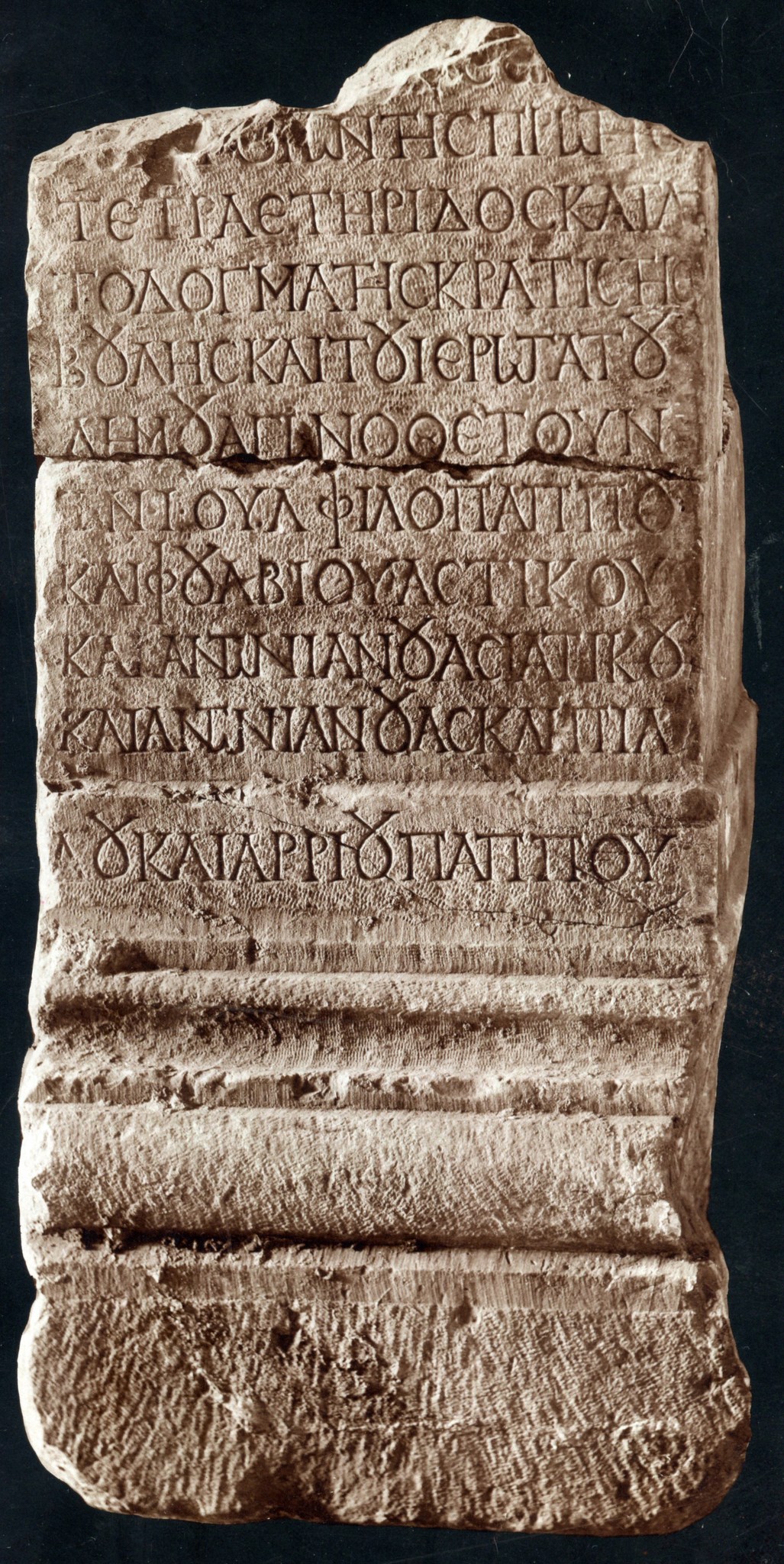
New cover photo for social media: Pythian games held in ancient Serdica
Introducing a new cover photo: Pythian games in ancient Serdica!
The inscription we’ve chosen for our new cover photo (IGBulg IV 1910) attests to the celebration of Pythian games in ancient Serdica, now modern Sofia, Bulgaria. The original Pythian games, one of the four Panhellenic games of ancient Greece, were held every four years in honour of Apollo at Delphi since the 6th century BC. They included music, dancing, singing, painting, and poetry contests, to which physical disciplines were subsequently added. However, many new games were established throughout the eastern Mediterranean during the Hellenistic and Roman periods. To gain prestige and attractiveness, those were based on the model of the Panhellenic games, in particular the Olympics (for its athletic contests) and the Pythia (for the musical contests), and were thus called is-Olympic or iso-Pythian (Gr. ἴσος: equal to). It is only befitting that the model of the Pythian games was adopted in Serdica, for it is known that the cult of Apollo was of great importance to the city, probably due to the many healing mineral springs in the area.
The story of this inscription could serve as a prime example of the importance of accessible imagery and data when it comes to epigraphy. Though the names of the agonothethes (representatives of different states elected for four years to superintend the various contests) at the time were enlisted, the absence of consular dating sparked a decades-long debate on the exact dating of both the relic and the games. The breakthrough came with the rediscovery of another inscription from Negovan (IGBulg IV 1986). Though initially published back in the 19th century, it was only transcribed in text form, without any accompanying description or image of the stone. As a result, later scholars were unaware of its striking resemblance to the Serdica inscription: the letters and the gorgeous ligatures in both inscriptions are virtually identical in design and height, and the base dimensions match perfectly. These similarities confirm that both inscriptions were crafted by the same stonemason at the same time, as dated by the consular dating of the Negovan inscription. Therefore, it is currently understood that the Pythian games of Serdica took place around 240 AD, during the reign of Emperor Gordian III, who is believed to have played an important role in the establishment and reorganisation of agonistic festivals throughout the Balkans, probably on the way to his military campaign in the East. Regrettably, it remains uncertain whether any more Pythian games were ever held again in Serdica.
Considering the history of epigraphics, such misunderstandings seem inevitable. Nevertheless, one of our main goals as Digital Epigraphists in the 21st century is to prevent any possible similar situations hereafter by providing detailed information and clear imagery of the inscriptions with open access to anyone wishing to study them.
To find out more details about the inscription, read this paper by Nicolay Sharankov:
Or gain a better understanding of the Pythian games here: