South-Eastern Europe in the period of the Roman principate (I-III c. AD) - PART 3
South-Eastern Europe in the period of the Roman principate (I-III c. AD) - PART 2
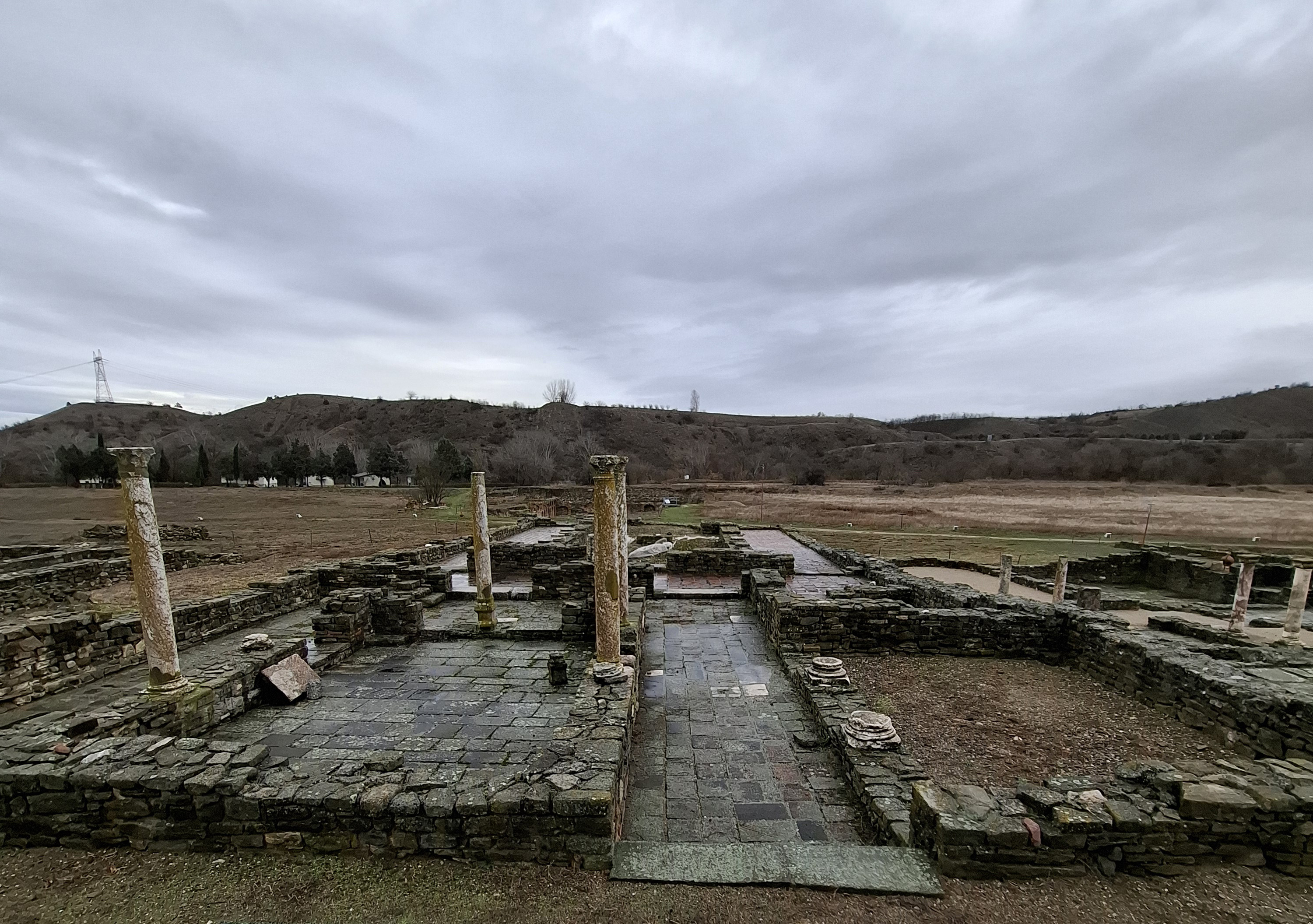
Stobi was the most important city along the middle course of the Axios River (modern Vardar) during the Roman period. Situated at the confluence of the Erigon River (modern Crna Reka) with the Axios, the city occupied a strategic location along the main ancient communication routes: the Vardar–Morava road, which connected the Aegean basin with the Danube, i.e., the route Thessalonica – Viminacium and Sirmium, passing through Scupi and Naissus; the road to Serdica via Astibo, Tranupara, and Pautalia and another route that represented a branch of the Via Egnatia, diverging near Heraclea Lyncestis.
In ancient literary sources, Stobi is mentioned only a few times. The oldest and most significant reference comes from Livy, who describes Stobi as an “old city”, referring to the 2nd century BC (Livy XXXIX, 53, 15): “... not far from Stobi, the ancient city.” (haud procul Stobis, vetere urbe).
A particularly important piece of information for the history of Stobi during the formation of the province of Macedonia is that Aemilius Paulus allowed the Dardanians to purchase salt from Stobi, which belonged to the third meris, and he also set the price (Livy XLV, 29, 13): “... after not granting them Paeonia, he allowed them trade in salt; he ordered the third region to deliver salt to Paeonia and fixed the price.” This record shows not only that Stobi belonged to the third meris, but also that the city’s strategic position was already being utilized for trade purposes, which played a significant role in the local economy.
The earliest material remains found at Stobi have been discovered outside of a precise archaeological context – isolated finds dated from the Late Bronze Age through the Archaic and Classical periods. Archaeological excavations conducted during the 1970s revealed the transformation of the city from the Hellenistic to the Roman period, showing that the urban area expanded significantly over time. In the 3rd century BC, the small Hellenistic settlement was located on the left bank of the Erigon River, near its confluence with the Axios. It is possible that an earlier settlement, dating to the 4th century BC or even earlier, existed on the same site or somewhere in the yet-unexplored areas along the left bank of the Axios. In the 2nd century BC, the population increased as a result of the creation of the Roman province and due to the trade in salt, which made Stobi an important commercial centre within the third meris. The settlement of Roman military veterans, who moved into the city inhabited by indigenous Paeonian, Macedonian, and Hellenic populations, had a significant impact on the further development of Stobi.
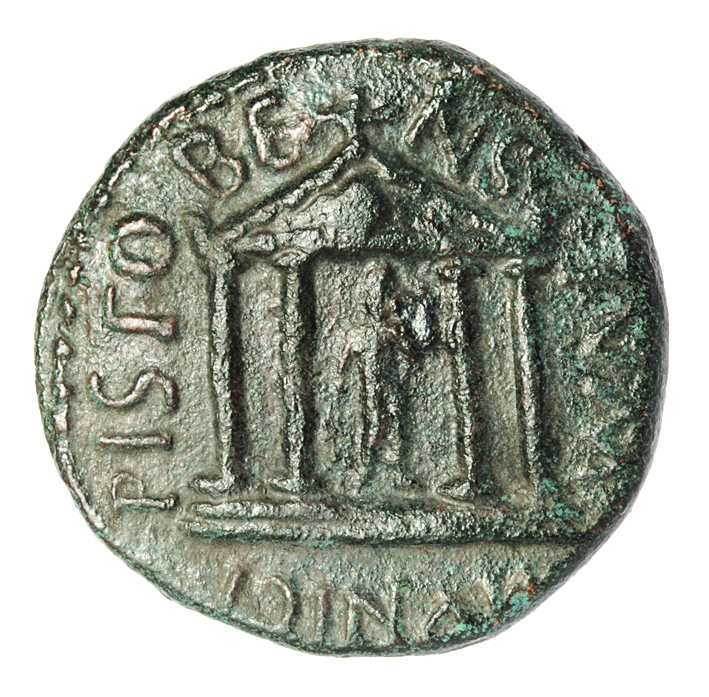 Coin of the Stobi mint, Trajan, 98/99 AD
During the early Imperial period, events occurred that reflected changes in the status of the city and its inhabitants. Pliny the Elder lists 150 cities in Macedonia, among them “oppidum Stobi civium Romanorum” (Nat. Hist. IV, 16). In her detailed study on the status of Stobi during the Roman era, Fanula Papazoglu concluded that the city functioned as an oppidum civium Romanorum before 30 BC, and that in 73 AD, when the first coinage of Stobi appeared bearing the legend Vespasianus cos. IIII censor, and on the reverse mun(icipium) Stob(ensium), this confirms the change in the city’s status.
Based on the known numismatic evidence, it is clear that under Emperor Vespasian (73 AD), Stobi became a municipium. In inscriptions, the city is referred to as municipium Stobensium or in Greek as ἡ Στοβαίων πόλις.
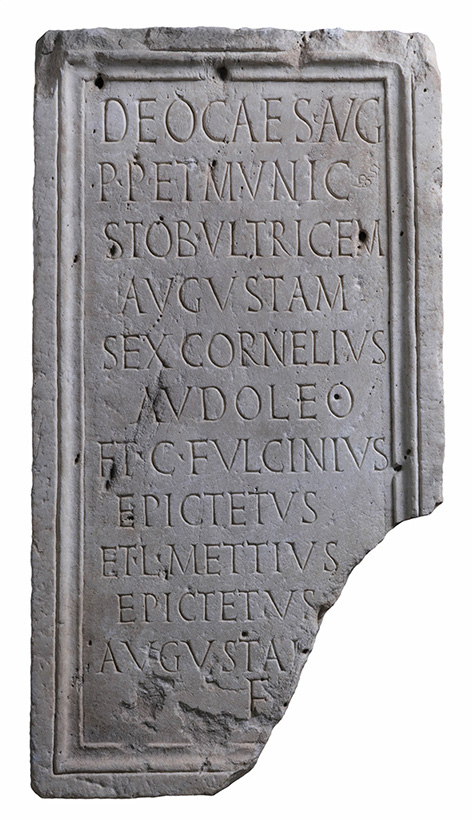 Dedication from Augustales to the Emperor and Ultrix Augusta
The importance of Stobi is also evidenced by the existence of a mint, which, with short interruptions, operated for about 150 years (73–217 AD). Its role was to supply small bronze coinage not only to the local population, but also to the inhabitants of Upper Moesia up to the Danube, where no mints existed at that time (during the reign of Vespasian), while other minting centers were located mainly along the Macedonian coast.
From an archaeological perspective, the early Roman period in Stobi is much better studied. Excavations have shown that in the late 1st century BC, there began a significant expansion of the city’s area and an increase in population. The structures investigated from this period are of public or semi-public character. These include the so-called Casa Romana, the Building with Arches (whose function is still uncertain), the Temple of Isis, and the House of Polycharmos, none of which have yet been fully excavated.
The largest structure from the Early Roman period in Stobi is the theatre, which is significant not only from an archaeological and architectural standpoint, but also in terms of the city’s functioning and the composition of its population. Its construction was completed in the third quarter of the 2nd century AD, and it remained in use until the end of the 4th century. All the seats in the theatre bear inscriptions with the names of those who rented them for specific periods, starting from the late 2nd century to the second quarter of the 3rd century. This was a common practice in nearly all ancient theatres, but the theatre of Stobi is unique because almost every seat was inscribed. In many cases, the names of successive renters can be seen, since two or three names are engraved on the upper surface, and inscriptions also frequently appear on the front edge. Unfortunately, a large number of these seats were reused in later antiquity in other buildings throughout the city, making it impossible today to view all the inscriptions. A particularly important aspect for the epigraphy and history of Stobi is that all seat inscriptions are written in Greek, indicating that Greek remained the dominant language among most of the population, despite the city’s Roman legal status and the large number of Roman settlers. Most of the names are Roman nomina or cognomina, written in abbreviated form and usually in the genitive case. The seating arrangement in the theatre was organized according to phylai (tribes), whose names were engraved on the front sides of the seats. It is believed that there were 21 phylai, although only six have survived: Κ[λαυδί]α? (Claudia?), Μαρτία (Martia), Οὐαλερία (Valeria), [Μερ]κουρία (Mercuria), Οὐειβία (Vibia), and Τερεντία (Terentia).
The purpose of the theatre in Stobi was, of course, for theatrical and musical performances, and possibly also for official civic gatherings – something indicated by the seating arrangement according to the phylai. Archaeological research has also suggested that the theatre was used for gladiatorial and beast-hunting games (venationes), which has been confirmed by an inscription – an invitatio ad munera – referring to such events being held in the theatre.
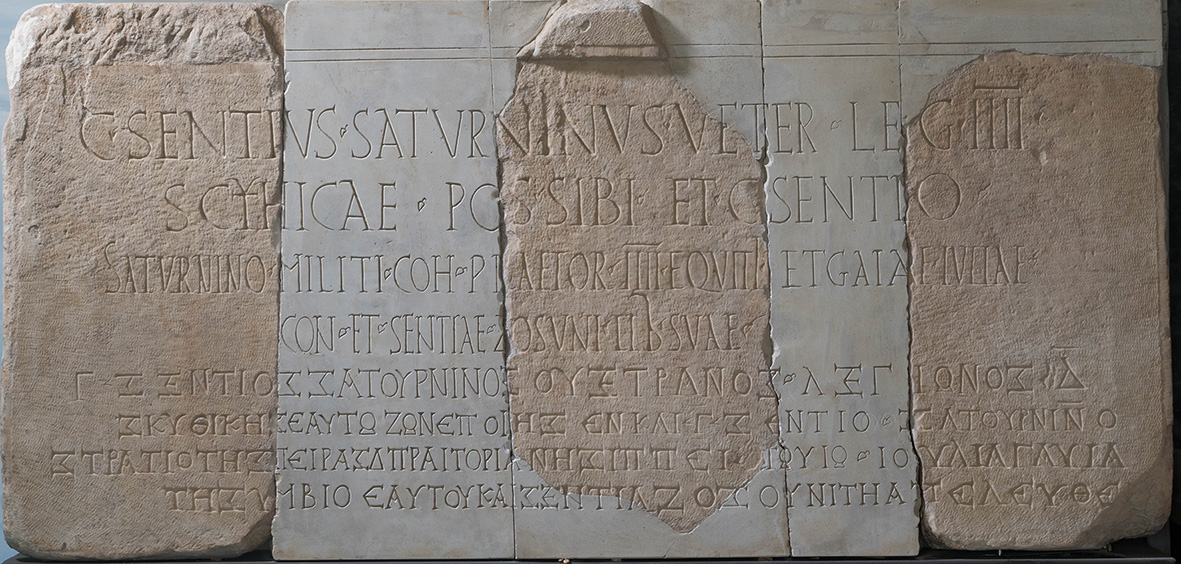 Grave slab of Gaius Sentius Saturninus, veteran of Legio IV Scythica and his family
The structure of Stobi’s population is reflected primarily through the funerary monuments. The city’s status after the Roman conquest and during the early imperial period suggests that all free-born inhabitants of Stobi possessed Roman citizenship. Citizens of Stobi were registered in the tribe Aemilia, as confirmed by inscriptions from Stobi, Scupi, Nicopolis ad Istrum, Neapolis in Judea, and Rome, where the tribal designation Aemilia (Stobis) appears in the onomastic formula.
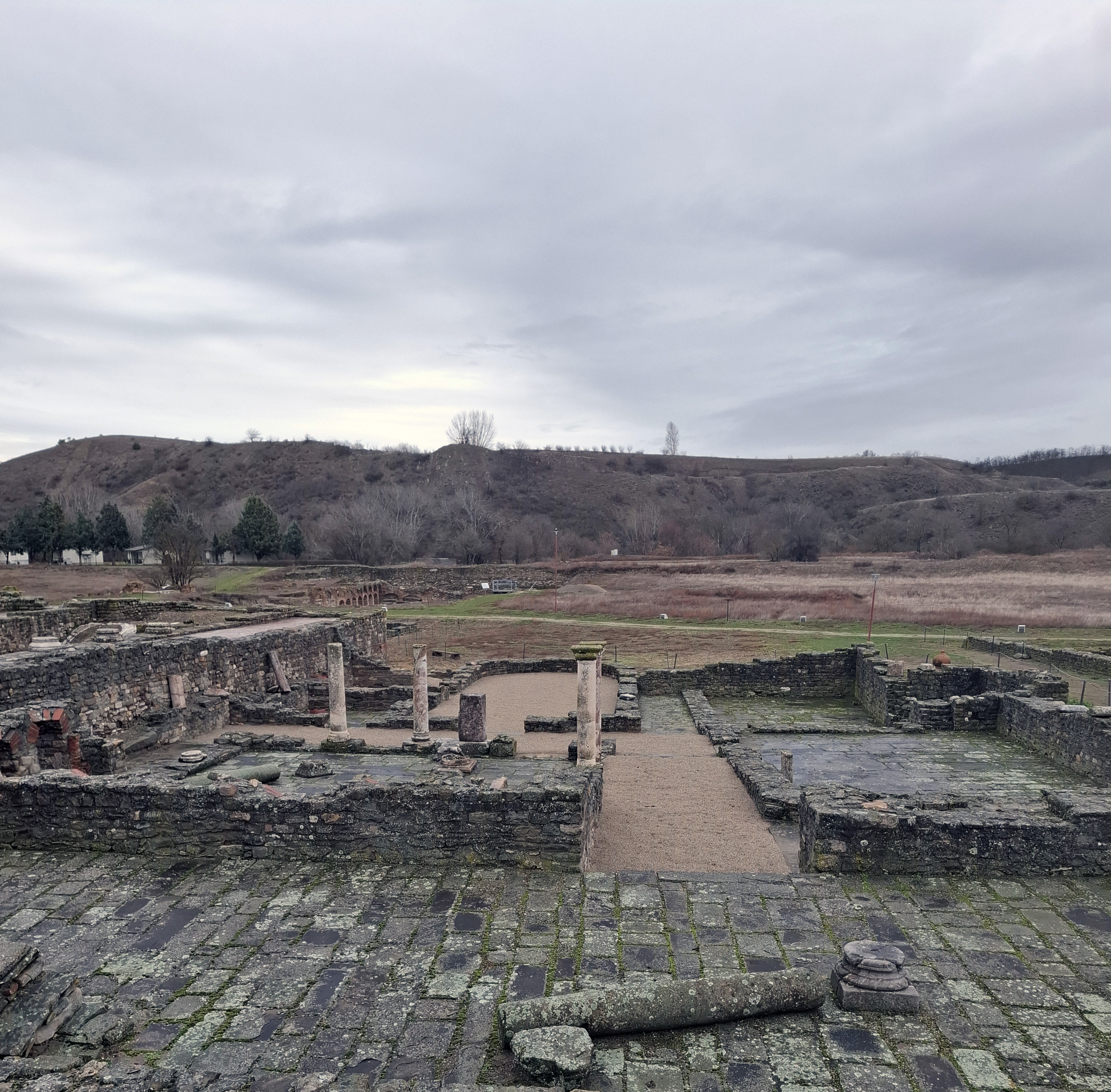
It is impossible to discuss Stobi without mentioning its most studied inscription, discovered in 1931 – the dedication by Tiberius Claudius Polycharmos. The double Roman gentilicium Tiberius Claudius is attested throughout the Roman Empire. The cognomen Πολύχαρμος was borne by many individuals from the eastern part of the Empire during the Roman period. In his onomastic formula, Polycharmos also includes the signum Achyrios – a name that is extremely rare. Apart from this occurrence, Achyrios is known only from a gold phiale from Sicily, probably dated to the 4th century BC. It has been suggested that the etymology of the name is Greek, derived from the adjective ἄχυρον, though some scholars consider it a transcription of a Hebrew name. In this case, that last interpretation would be the only indication of Jewish origin for Polycharmos. It is worth noting that only two other Jews from early Roman Stobi are known by name: Ἀλέξανδρος, the frontistes of the synagogue, and Ποσιδωνία, who dedicated a testament to God. Both bear Greek names, which, like in the case of Polycharmos, illustrates the gradual loss of clear ethnic markers in Stobi during the 2nd and 3rd centuries AD.
In Stobi, located precisely on the border between the two halves of the Roman Empire, between two cultural spheres that, despite their separate historical developments, eventually became one state functioning together, we can expect a blending of the two principal components of the Empire’s cultural history. When we try to place Stobi within a clear cultural framework, it becomes evident that such classification is impossible. The inscriptions found in the city are written in both Latin and Ancient Greek, seemingly in equal proportion. Adding further complexity to this picture is the strong Oriental element, which, although epigraphically attested by only one inscription (besides the votive texts of members of the Jewish community), is nonetheless present through other archaeological finds. The presence of Latin as the official language should not be underestimated, even though, as in the rest of the eastern provinces, Greek predominated. It is noteworthy that public inscriptions are written in Greek, while imperial dedications are in Latin, though not always consistently so. By the 2nd century AD, a larger number of inscriptions appear in Greek, but with a clear distinction in language use according to the legal status of the citizens.
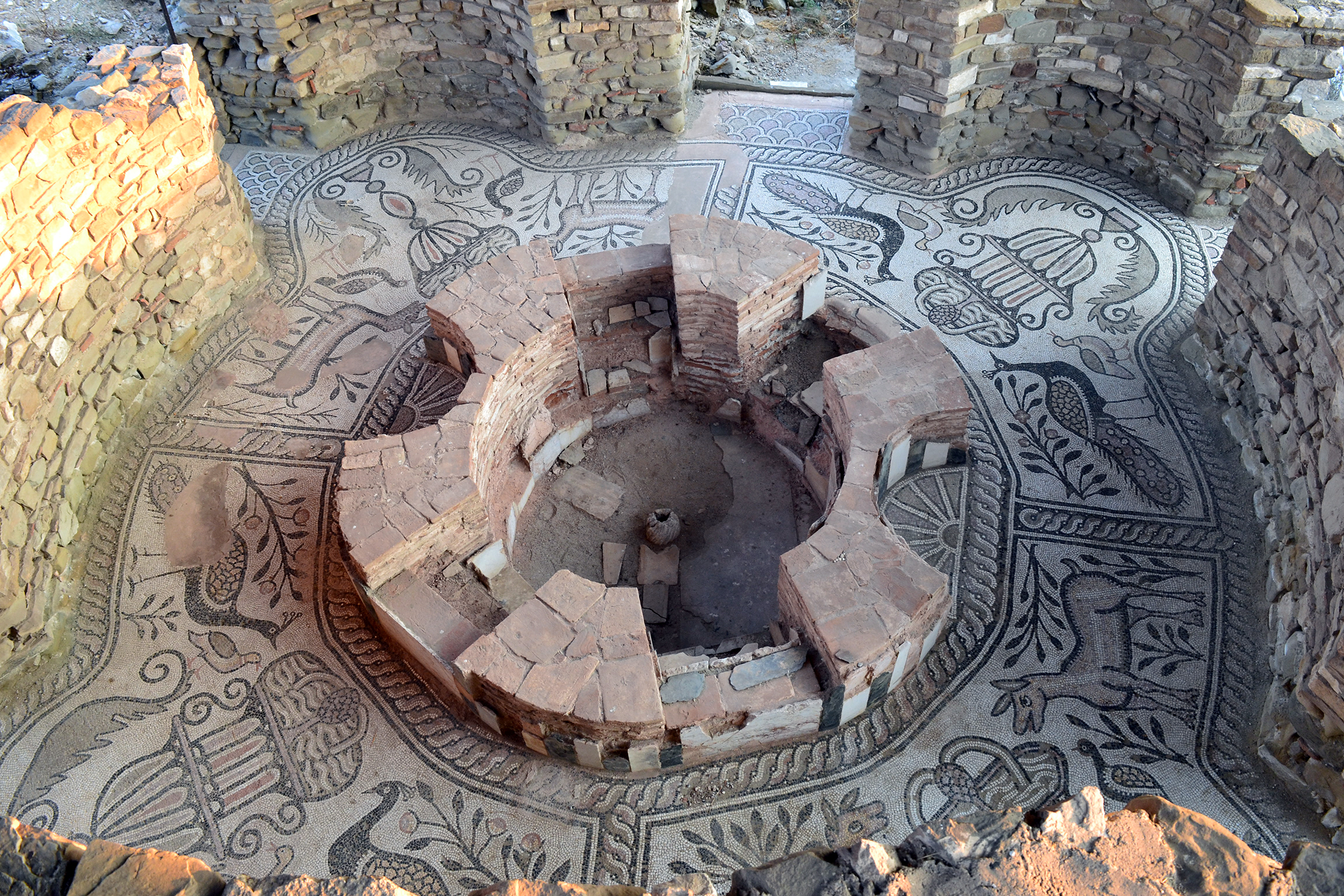
In the early 4th century Stobi became the seat of an episcopate. This is made clear from the lists of bishops attending church Councils: Budius, who was present at the Council of Nicaea in 325 AD, is the first known bishop from Stobi, while bishop Nicolaos is said to have attended the Council of Chalcedon in 451 AD. Early Christian activity has been confirmed also by the excavations of seven basilicas and three baptisteries in the city and its vicinity. These facilities were all used simultaneously in the 5th century, which suggests that Stobi had by then a large Christian community.
In the mid-5th century, Stobi was attacked and burned by the Huns, and in 479 AD it was plundered by the Ostrogoths, though it was later rebuilt. As a result of the movements of the Slavs, Avars, and Kutrigurs, as well as natural disasters, urban life in the city came to an end by the late 6th century.
Slavica Babamova
Further reading:
Papazoglou Fanoula, Les villes de Macédoine a l’époque romaine, Supplement BCH, Paris 1988, 313-323.
Wiseman James, Archaeology and History at Stobi, Macedonia, in: Ch. B. McClendon (ed.), Rome and the Provinces, New Haven 1986, 37–50.
Wiseman James, The City in Macedonia Secunda, in: Villes et Peuplement dans l’Illyricum protobyzantine, Rome, 1984, 289–314.
Wiseman James, Multidisciplinary Research in Classical Archaeology: An Example from the Balkans, in: Contributions to the Aegean Archaeology: Studies in honor of W. A. McDonald, 1985, 259–281.
Wiseman James, Municipal Tribes and Citizenship in Roman Macedonia, Ancient Macedonia V, 3, 1994, 1757–1763.
Микулчиќ Иван, Стоби, антички град, Скопје, 2003.
Wiseman James, Jews at Stobi, Kačić, Zbornik u čast Emilija Marina, XLI–XLIII, 2009–2011, 325–350.
Јованова Ленче, Македонија во римскиот период (археологија), во: Македонија, милениумски културно-историски факти, Скопје, 2013, 801-810.
Babamova Slavica, Notes on the prosopography of Stobi, Studies in the Antiquities of Stobi IV, 2018, 110-127.
South-Eastern Europe in the period of the Roman principate (I-III c. AD) - PART 4