Teaching with Ancient Greek and Latin inscriptions
Teaching Universal Values with Ancient Greek and Latin Inscriptions
Epigraphic monuments testify to many different aspects of human life and therefore offer endless possibilities for teaching and learning ‒ not only Latin and Ancient Greek grammar, but also history, geography, literature, art, sociology, natural sciences and many other school topics. Inscriptions can play an important role in fostering cultural and heritage awareness, introducing students at an early age to the value of cultural heritage and its preservation. Most importantly, they can teach students about universal values as a link between the past, present, and future, helping them recognise the bonds that underlie every society and drive progress forward.
There are many positive examples of introducing epigraphy into the classroom, including visits to museums, lapidariums, and archaeological sites, where students can see actual monuments in their proper context and engage all their senses to explore and learn.
Digital collections of inscriptions, however, offer different possibilities. Being open-access, they make the use of epigraphy possible even when visiting a museum or archaeological site is not an option. These collections are linked to many other digital resources, which significantly facilitates teaching and learning. They are interactive, allowing teachers and students to follow their own interests and curiosity easily. Finally, digital resources and tools come naturally to new generations.
Here are a few suggestions for teachers on how to use the PROMETHEUS digital collection of inscriptions and storytelling platform for educational purposes:
1. Introduce students to the essentials of epigraphic culture. Explain briefly how inscriptions were made in antiquity and what their purposes were. Discuss the different categories of inscriptions. Ask students to recognize modern examples of engraving ‒ such as dedications on monuments, gravestones, business signs, signs on public buildings, road signs, or phrases engraved on everyday objects, graffiti.
Then, ask students to use the relations index in the PROMETHEUS digital collection and choose one concept ‒ such as love, family, or power ‒ to explore in the collection of inscriptions and stories. In a general discussion, invite different groups of students to explain briefly what motivated their choice and what love, family, or power means to them. Next, ask them to read, watch, or listen to the inscriptions and stories related to their chosen concept and observe how various aspects of an inscription ‒ such as vocabulary, mentioned persons, text structure, decoration, or the shape of the monument ‒ reflect that particular idea. Finally, discuss whether the chosen concept held the same value for people in antiquity as it does for us today. Encourage students to create their own stories or write essays as homework.
2. Choose one inscription from the PROMETHEUS digital collection. Ask students to observe the specific shape of the monument and its decoration, and explain briefly how inscriptions were made in antiquity and what their purposes were. If the students have basic knowledge of Latin or Ancient Greek, you can start with the photograph and let them identify the letters and transcribe the inscription. Next, ask them to recognize particular words and work on translating the text. Depending on their level of prior knowledge, you can support them by providing a list of Greek or Latin words and asking them to identify specific forms of these words in the photograph of the inscription or in the text itself. Show students how to use online Ancient Greek and Latin dictionaries and digital libraries of ancient texts.
If the students do not have prior knowledge of Greek or Latin, use the provided translation. Interpret the content of the inscription together and discuss its meaning and various aspects. Read, listen to, or watch a story related to the inscription. Ask students to describe the content using one or several key concepts ‒ such as health, death, foreigners, women, and so on ‒and to find modern examples that correspond to the themes of the inscription. Encourage them to observe similarities and differences between the ancient and modern world. Do we share the same values as people in antiquity? Do we express love or grief in the same way? Are knowledge and success equally important for everyone? What about freedom and personal security? The discussion could take many possible directions. Encourage students to create their own stories or write an essay for homework.
3. Choose a topic and use one or several inscriptions from the PROMETHEUS digital collection of inscriptions and storytelling platform to illustrate key points and stimulate discussion. For example, to discuss the status of women in antiquity, use inscriptions such as the Testament of Antestia Fusca from Stuberra; the Funerary stele of Domitia Ursa and Serenia Quarta from Singidunum or the Sarcophagus of Aelia from Nikopol. Or to discuss the education in antiquity, use inscriptions such as the Honorary inscription for M. Ulpius Genialis from Stara Zagora or the Statue base in honour of Aurelius Krates, son of Ptolemaios, erected by the Dassaretii from Lychnidos. Compare the epigraphic evidence with available Ancient Greek and Roman literary sources. Teach students how to use relevant digital databases and materials. Ask them to find modern parallels related to the topic. Discuss how the chosen topic could be used to create a narrative for presenting epigraphic heritage to a wider audience. Finally, create a story together.
Resources on using inscriptions as an educational tool:
Ashmolean Latin Inscriptions Project
Liddel, P. 'The Attic Inscriptions: Education Project', Journal of Classics Teaching. 2022;23(45):35-39. doi:10.1017/S2058631021000428.
Liddel P. Greek Inscriptions: insights and resources in the classroom and beyond. Journal of Classics Teaching. 2017;18(35):43-47. doi:10.1017/S205863101700006X.
Ragolič, A. 'Epigraphy as a tool for learning Latin. The case of the Prežihov Voranc Primary School in Ljubljana, Slovenia', in: Orlandi, S. et al. (eds.) Information Technologies for Epigraphy and Cultural Heritage. Proceedings of the First EAGLE International Conference, Sapienza Università Editrice, Roma, 2014, pp. 205-220.
School resources. British Epigraphic Society
.Smith, L. Uses of Heritage, Routledge, Abington, Oxon – New York, 2006.
Elena Džukeska
Stone Bingo
Teachers can organise this activity in collaboration with a local lapidarium or museum. It is recommended that it be carried out after students have been introduced to the basic types of inscriptions, their functions, physical and linguistic characteristics, and their broader significance. Students should also become familiar with common linguistic conventions, formulas, abbreviations, ligatures, and symbols (such as those indicating a centurion or a sestertius) that appear on inscriptions.
During class, select several representative inscriptions of different types (e.g., funerary and votive monuments, milestones, sarcophagi, altars, etc.). Read and analyse them together, explaining the abbreviations, formulas, and overall meaning of each text.
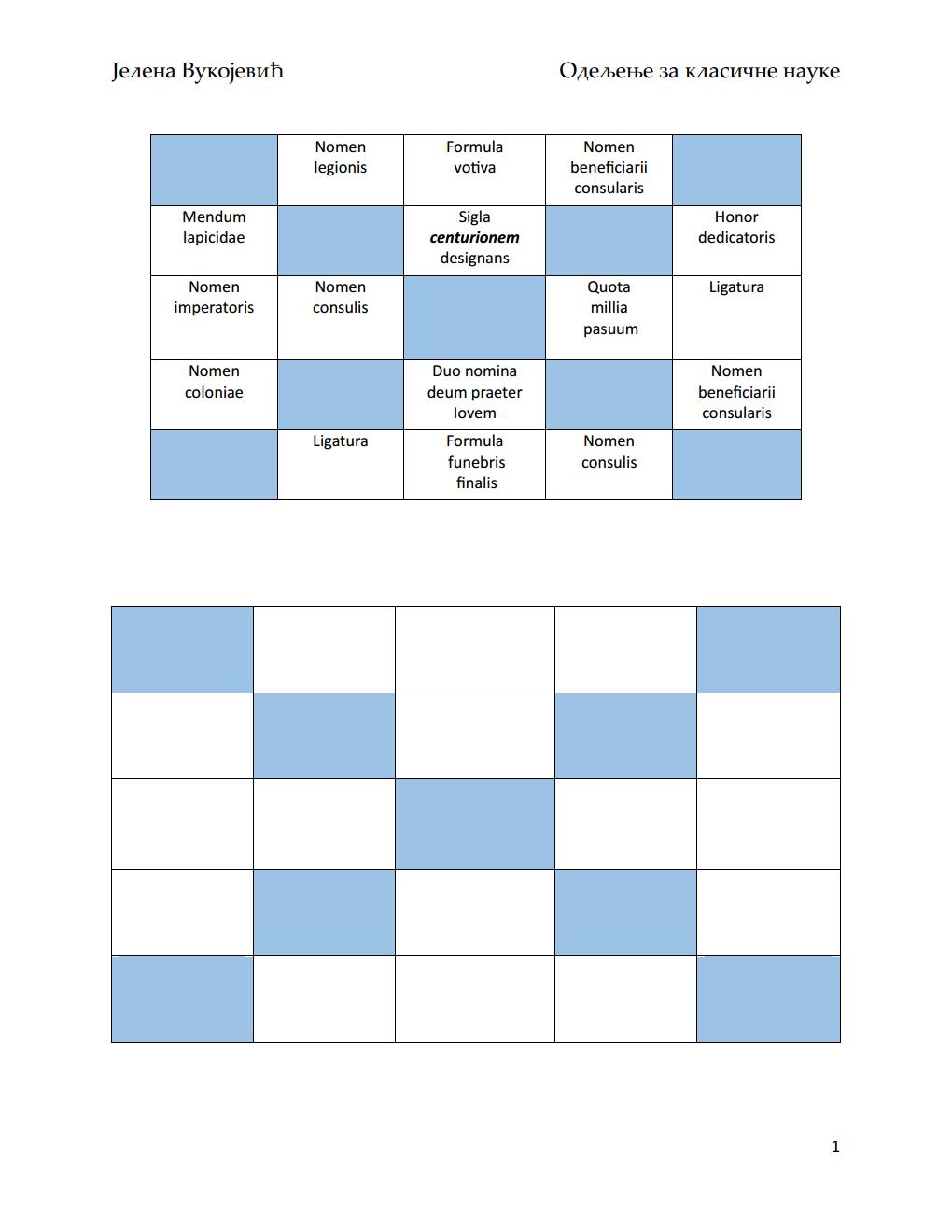
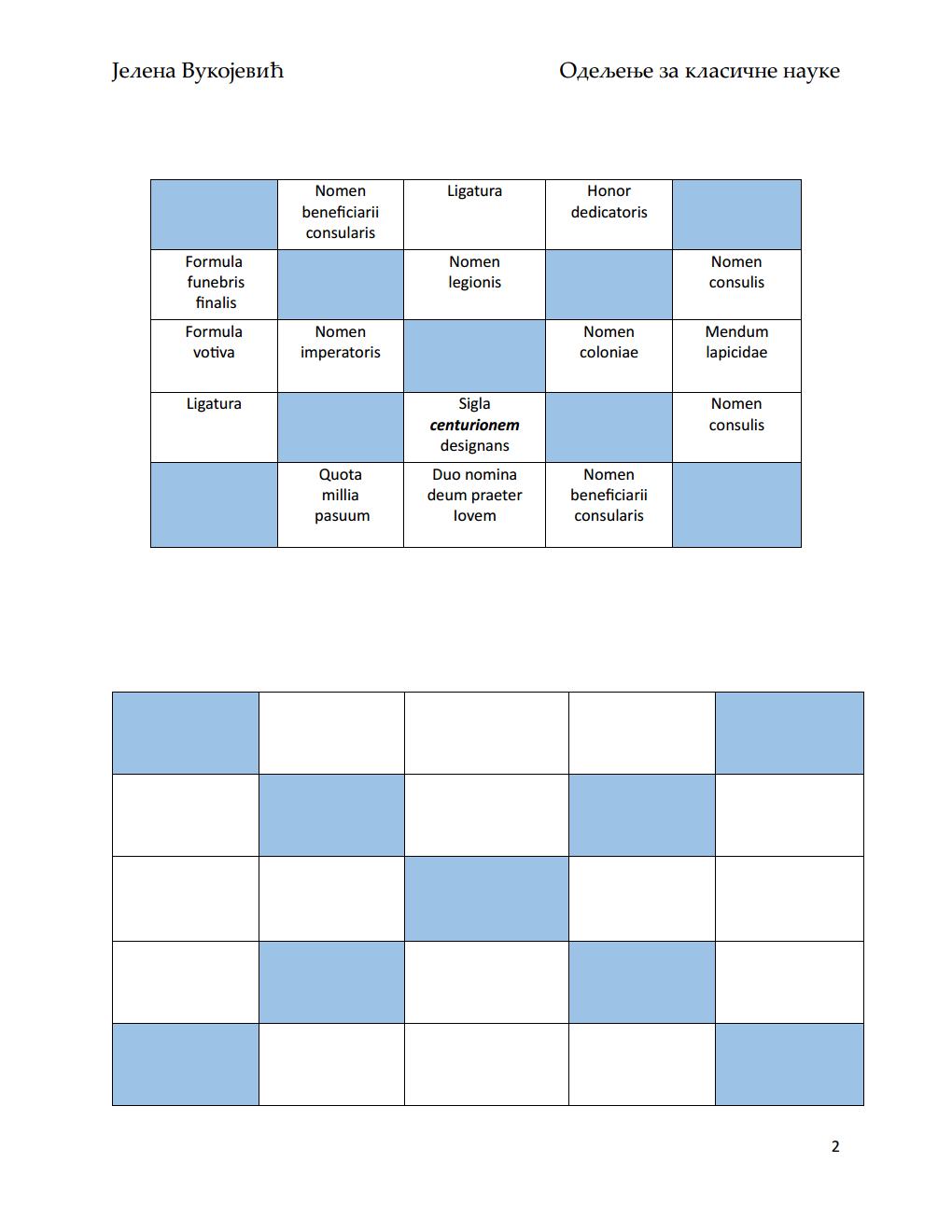
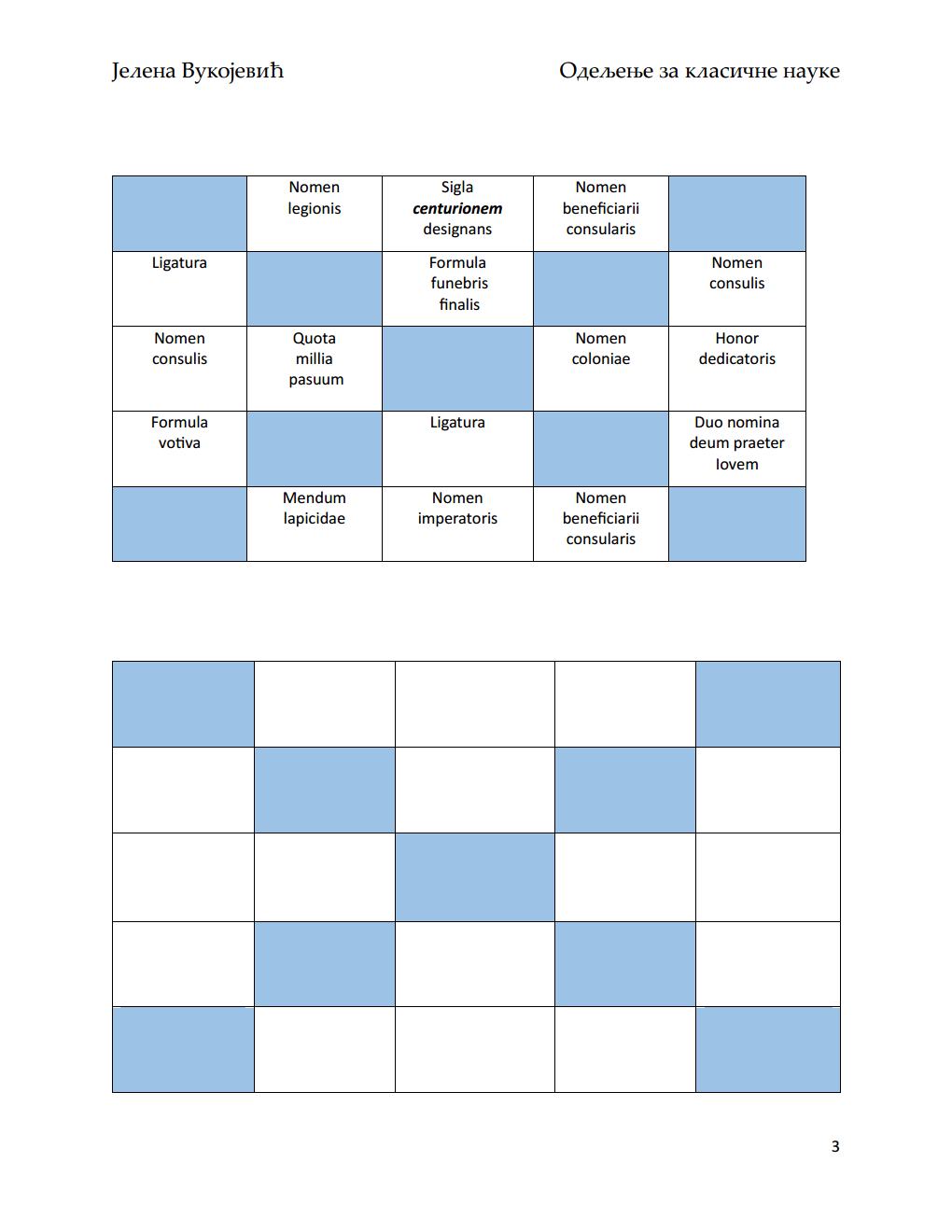
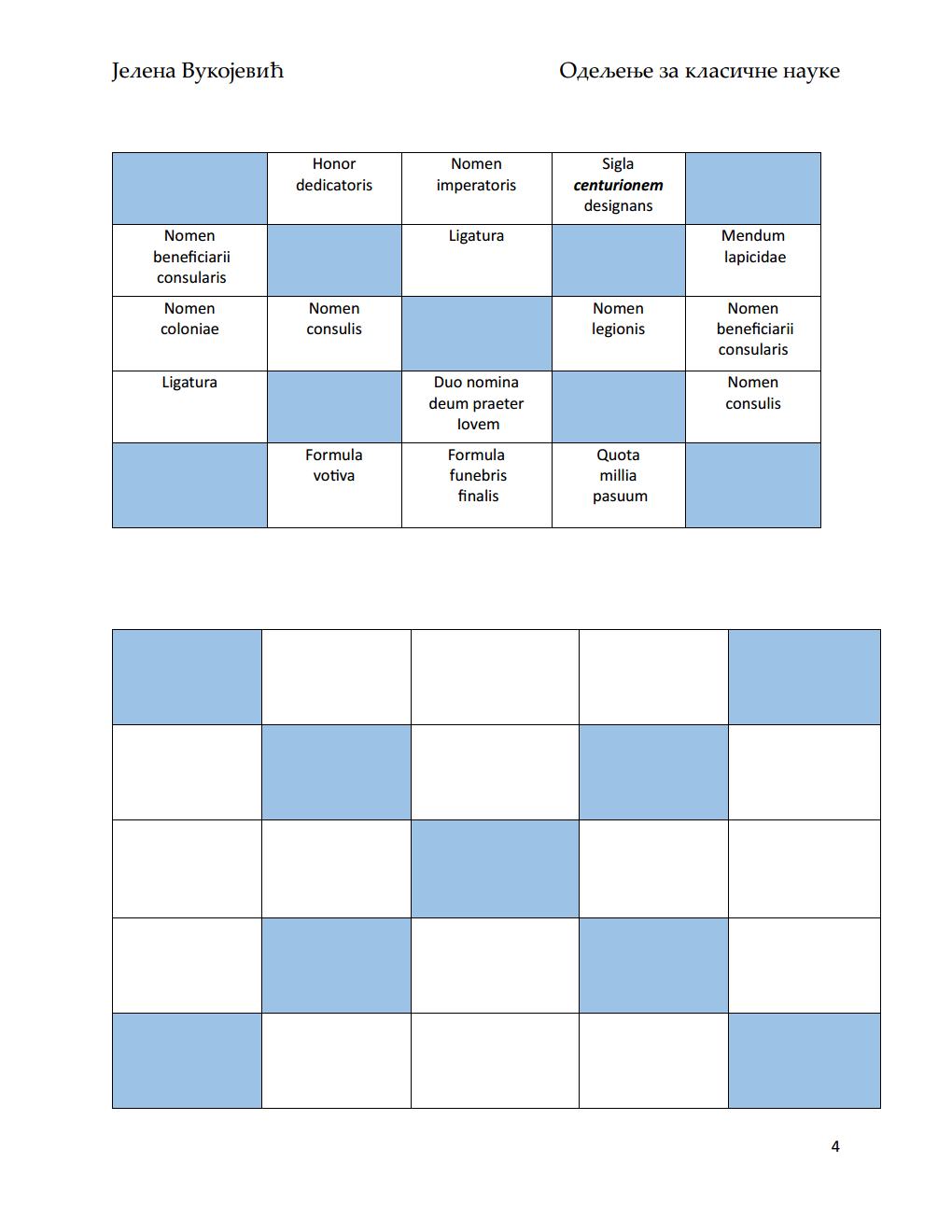
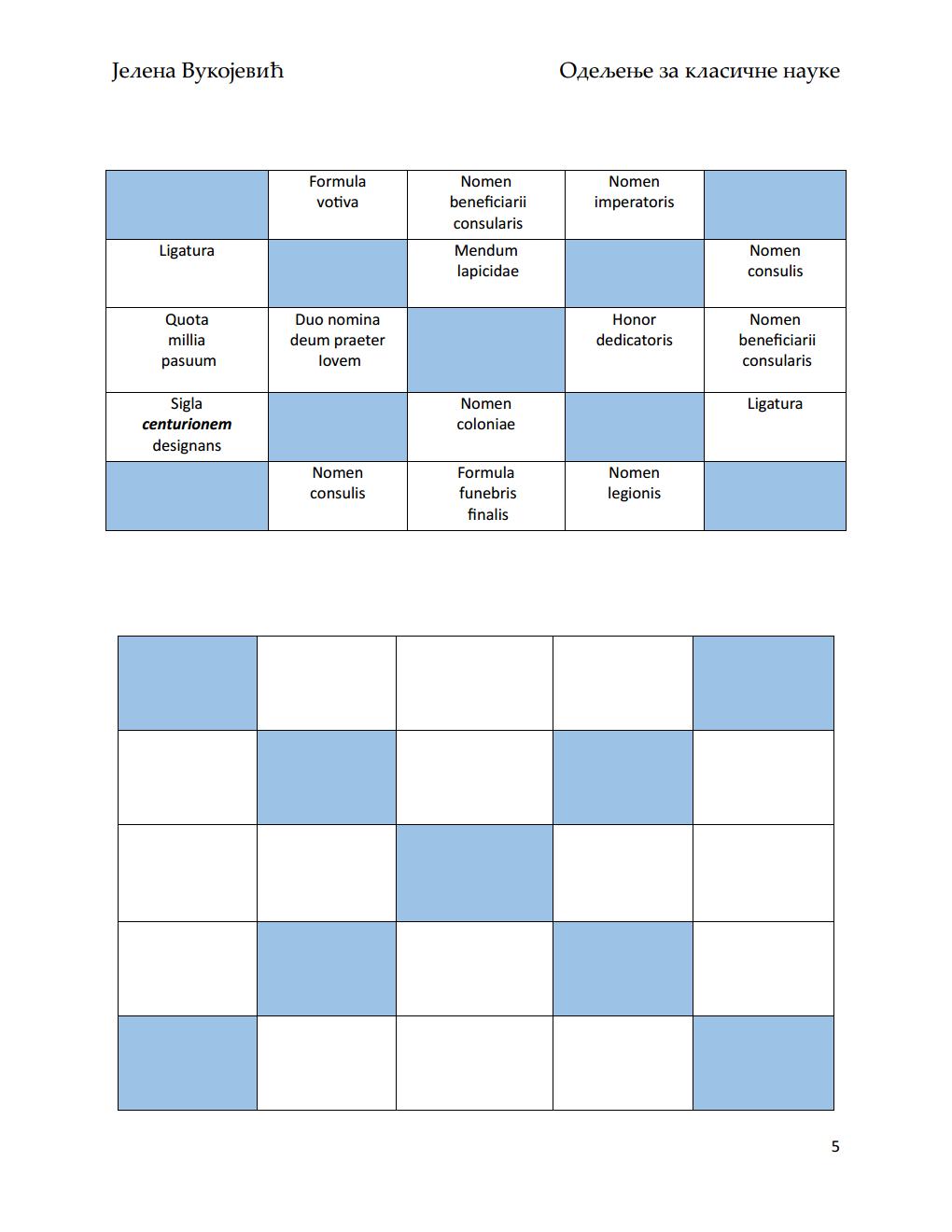
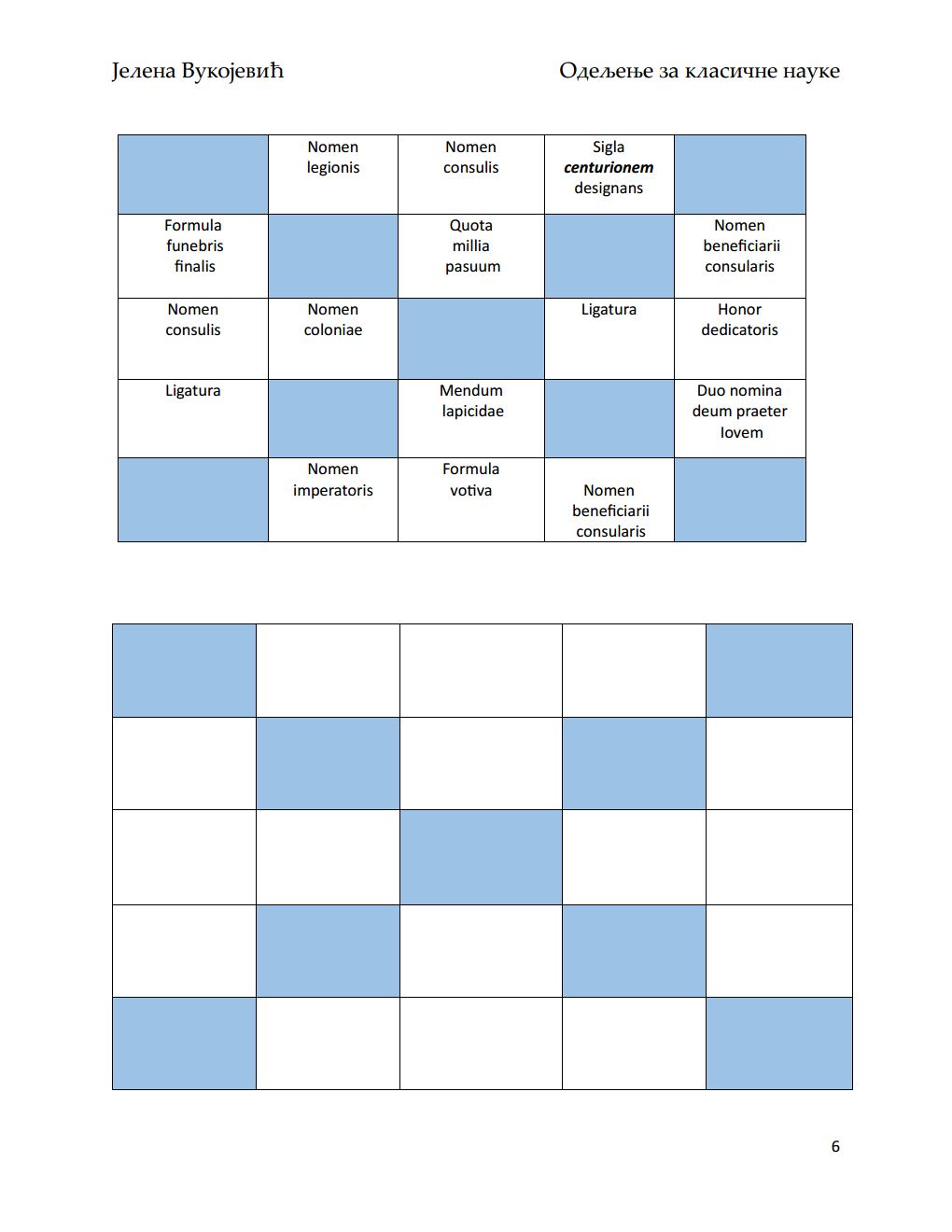
The Stone Bingo activity offers students a fun and engaging way to apply their classroom knowledge while interacting with real inscriptions. The main goal of the game is for students to correctly fill out their “bingo” cards by finding answers on the inscriptions.
Students should be divided into groups (for example, four members per group) and given bingo cards containing various tasks. These tasks might include finding specific formulas, symbols, ligatures, names of deities, and similar elements. The key point is that all answers must be discovered by reading the inscriptions themselves. It is recommended that all groups have the same set of tasks, though the arrangement of the target items on each bingo card can differ. The teacher may also prepare small symbolic prizes for the group that first completes its bingo card correctly (for example, stickers, bookmarks, or similar items).
The materials provided in the appendix contain tasks written in Latin, though they may also be adapted for use in the students’ native language.
Jelena Vukojević
Detectives in the Lapidarium
Teachers can organise this activity in collaboration with a local lapidarium or museum. It is recommended that it be carried out after students have been introduced to the basic types of inscriptions, their functions, physical and linguistic characteristics, and their broader significance. Students should also become familiar with common linguistic conventions, formulas, abbreviations, ligatures, and symbols (such as those indicating a centurion or a sestertius) that appear on inscriptions.
During class, select several representative inscriptions of different types (e.g., funerary and votive monuments, milestones, sarcophagi, altars, etc.). Read and analyse them together, explaining the abbreviations, formulas, and overall meaning of each text.
The Detectives in the Lapidarium activity offers students an engaging opportunity to apply what they have learned in class through a playful and hands-on approach, while interacting directly with authentic inscriptions. The main task for each group is to locate a series of “mystery inscriptions.”
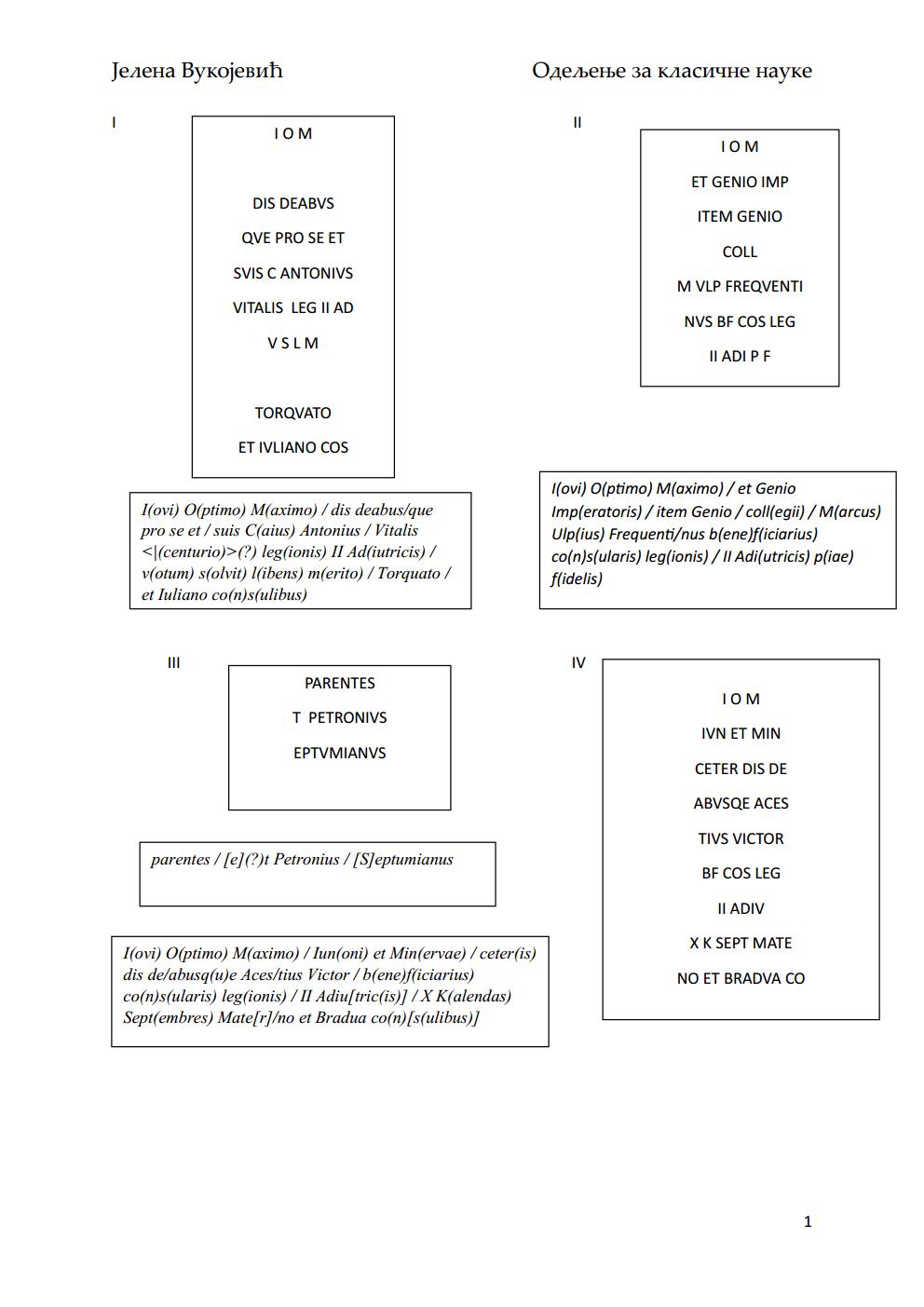
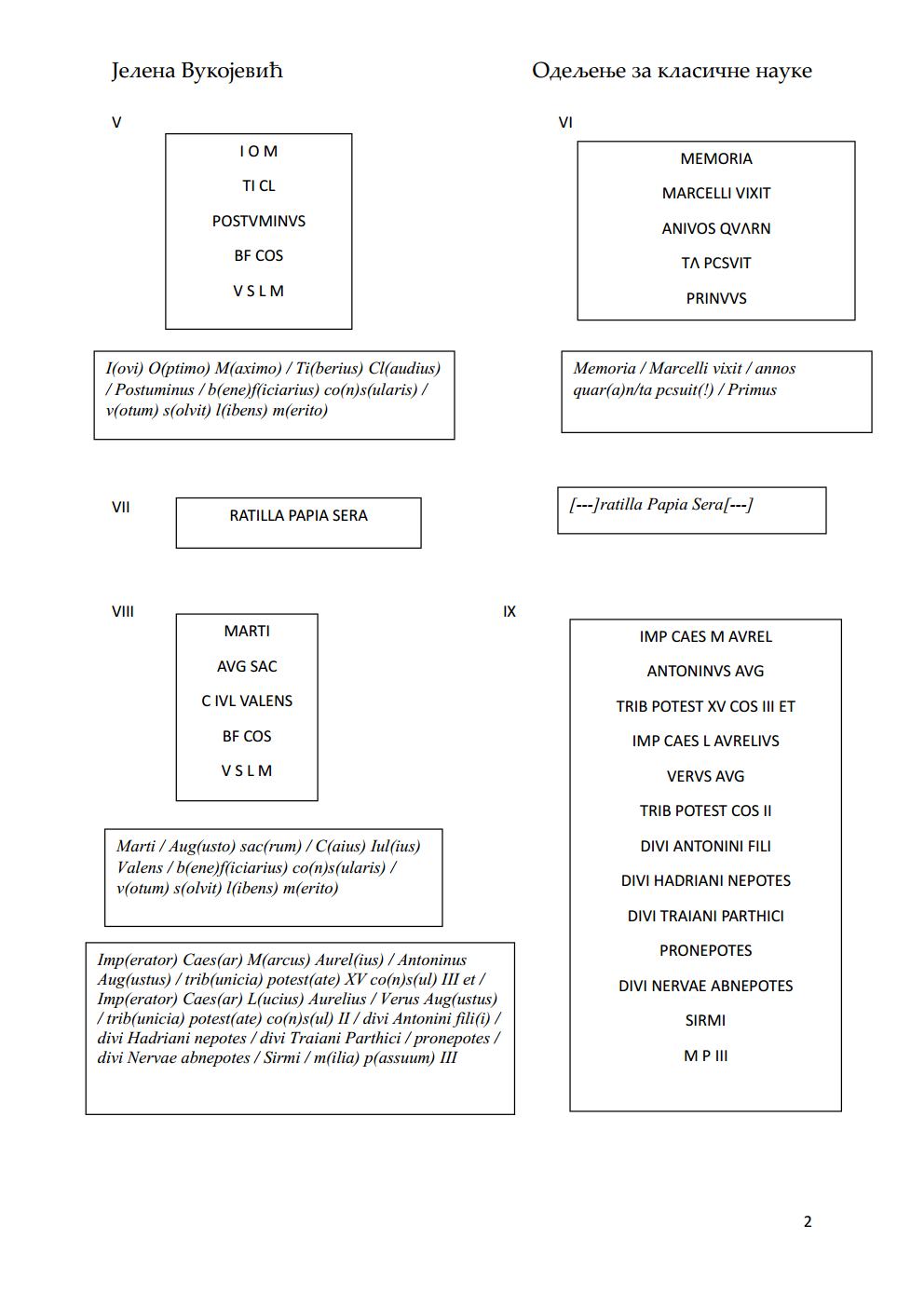
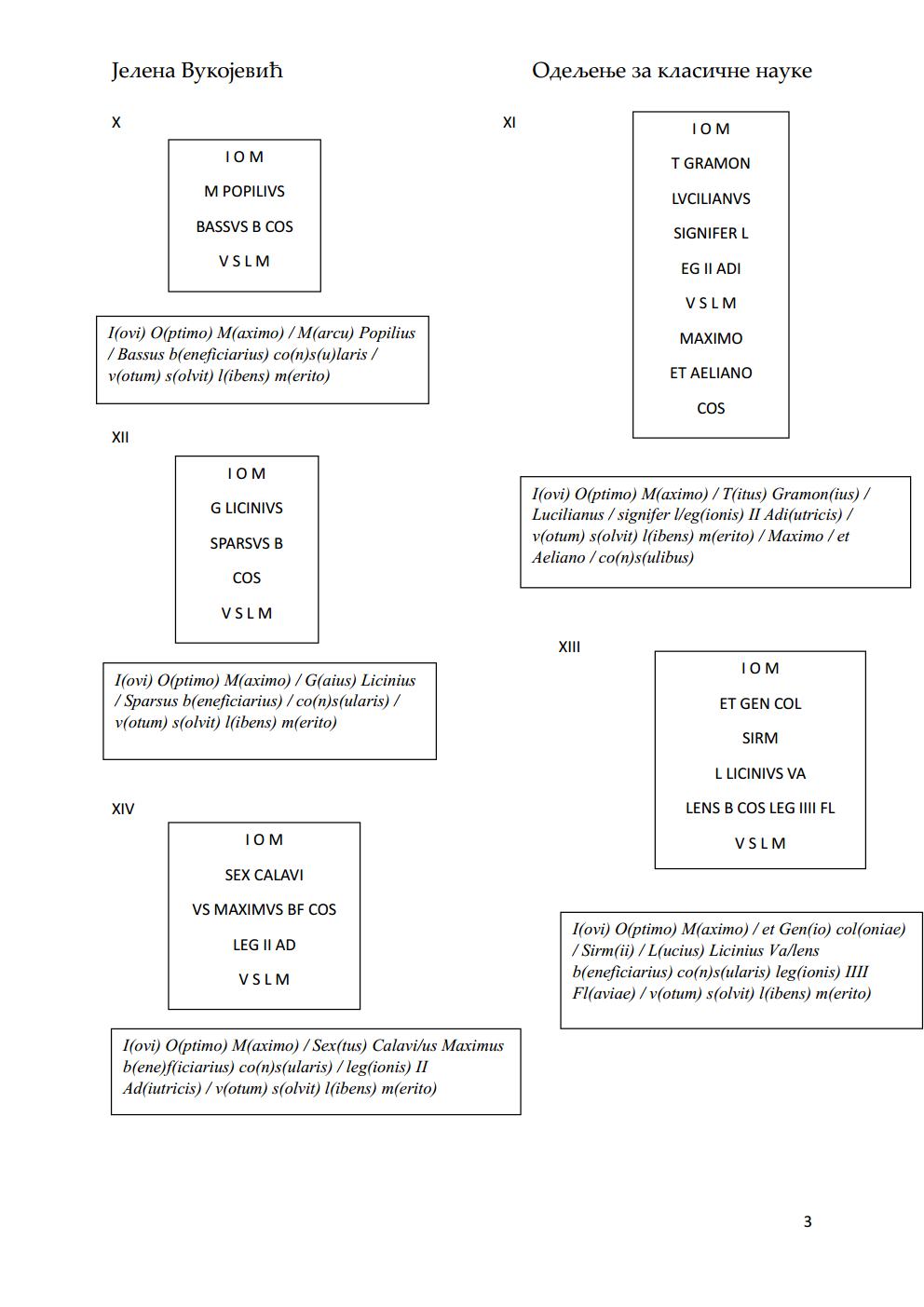
Students should be divided into groups (for example, four members each) and provided with worksheets featuring a schematic representation of the inscription field and a set of clues designed to help them identify the correct monument. These clues consist of excerpts from the target inscription, so students must carefully examine and read the inscriptions displayed in the lapidarium. Once they identify the right one, they complete the missing parts of the text on their worksheets based on what they observe on the stone itself.
Afterwards, with the teacher’s guidance, the inscription is deciphered, translated, and discussed. At the end of the activity, students can be given the answer key—that is, the full readings of the mystery inscriptions.
The accompanying materials were designed with the Lapidarium of the Museum of Srem in mind, but the activity can easily be adapted to the collections of any museum or lapidarium.
Jelena Vukojević
Stone by Stone
Teachers can organise this activity in collaboration with a local lapidarium or museum. It is recommended that it be carried out after students have been introduced to the basic types of inscriptions, their functions, physical and linguistic characteristics, and their broader significance. Students should also become familiar with common linguistic conventions, formulas, abbreviations, ligatures, and symbols (such as those indicating a centurion or a sestertius) that appear on inscriptions.
During class, select several representative inscriptions of different types (e.g., funerary and votive monuments, milestones, sarcophagi, altars, etc.). Read and analyse them together, explaining the abbreviations, formulas, and overall meaning of each text.
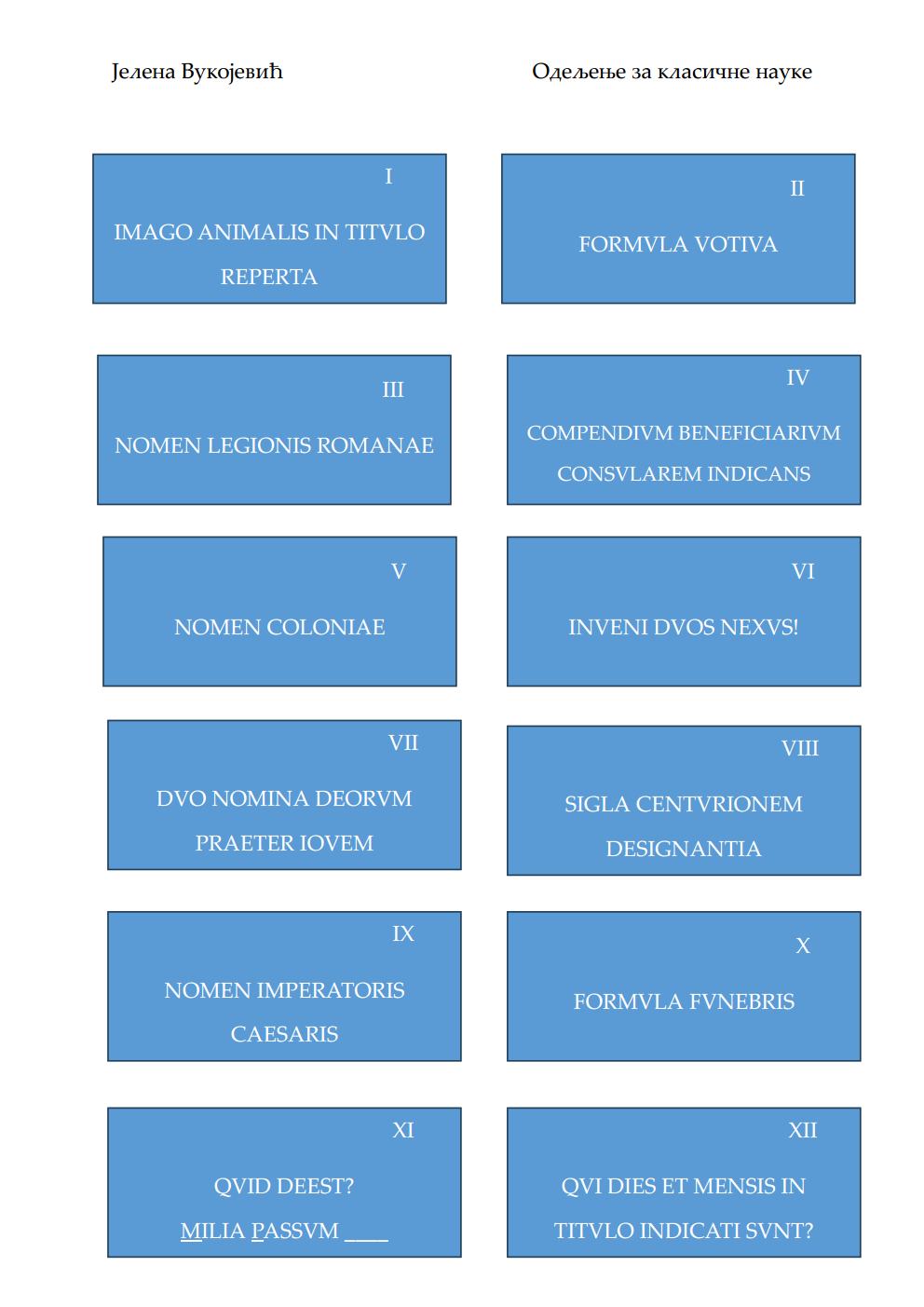
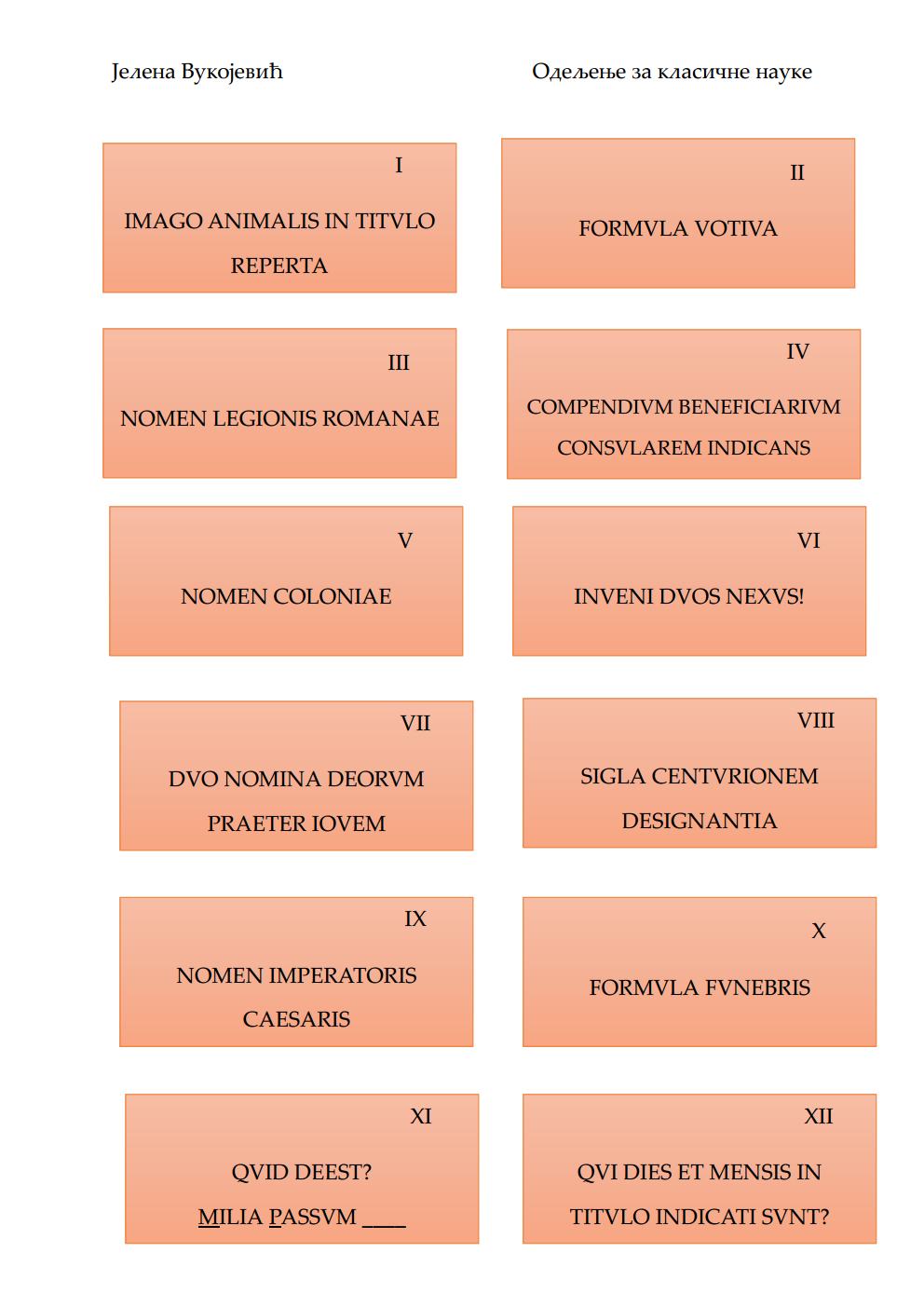
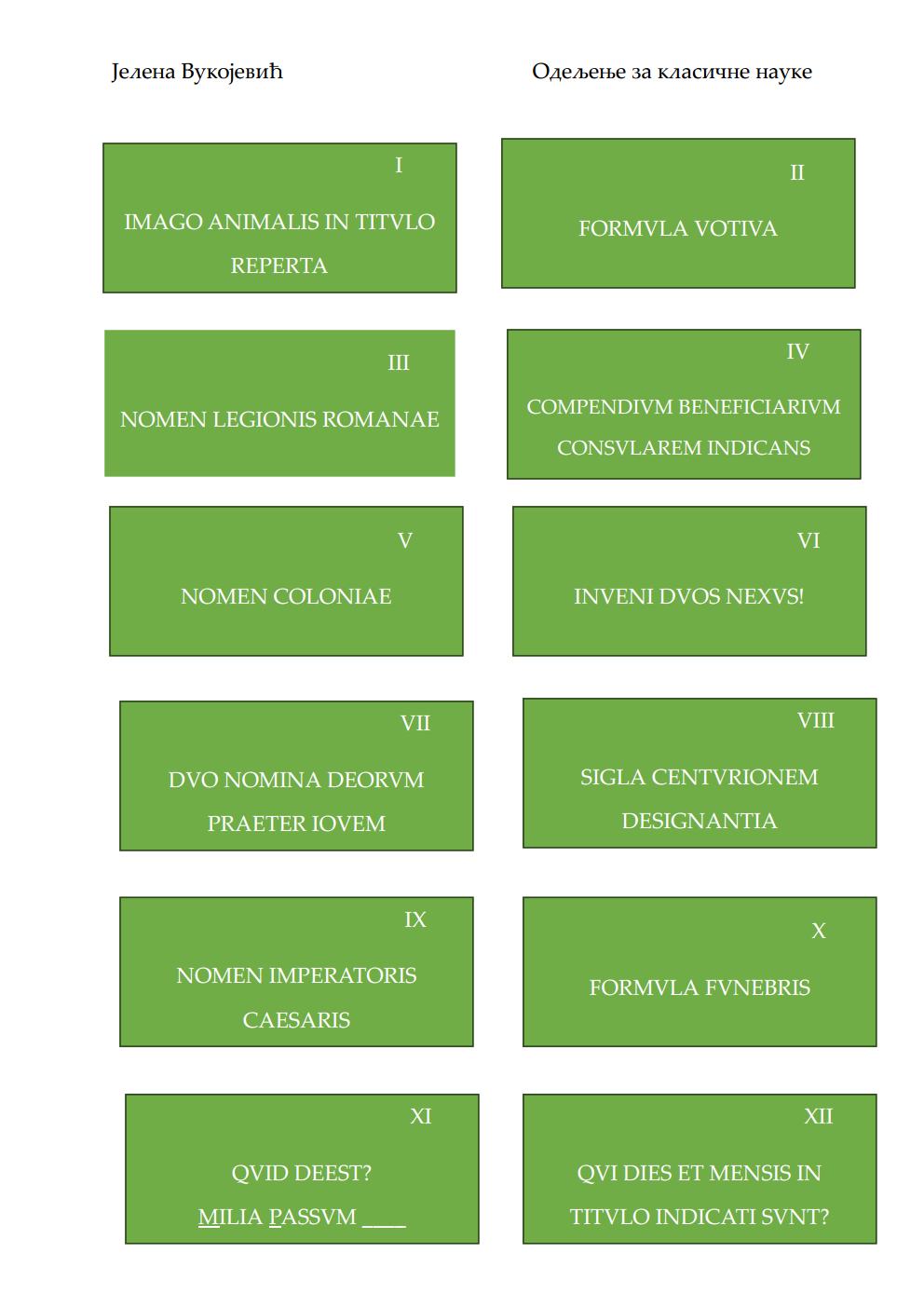
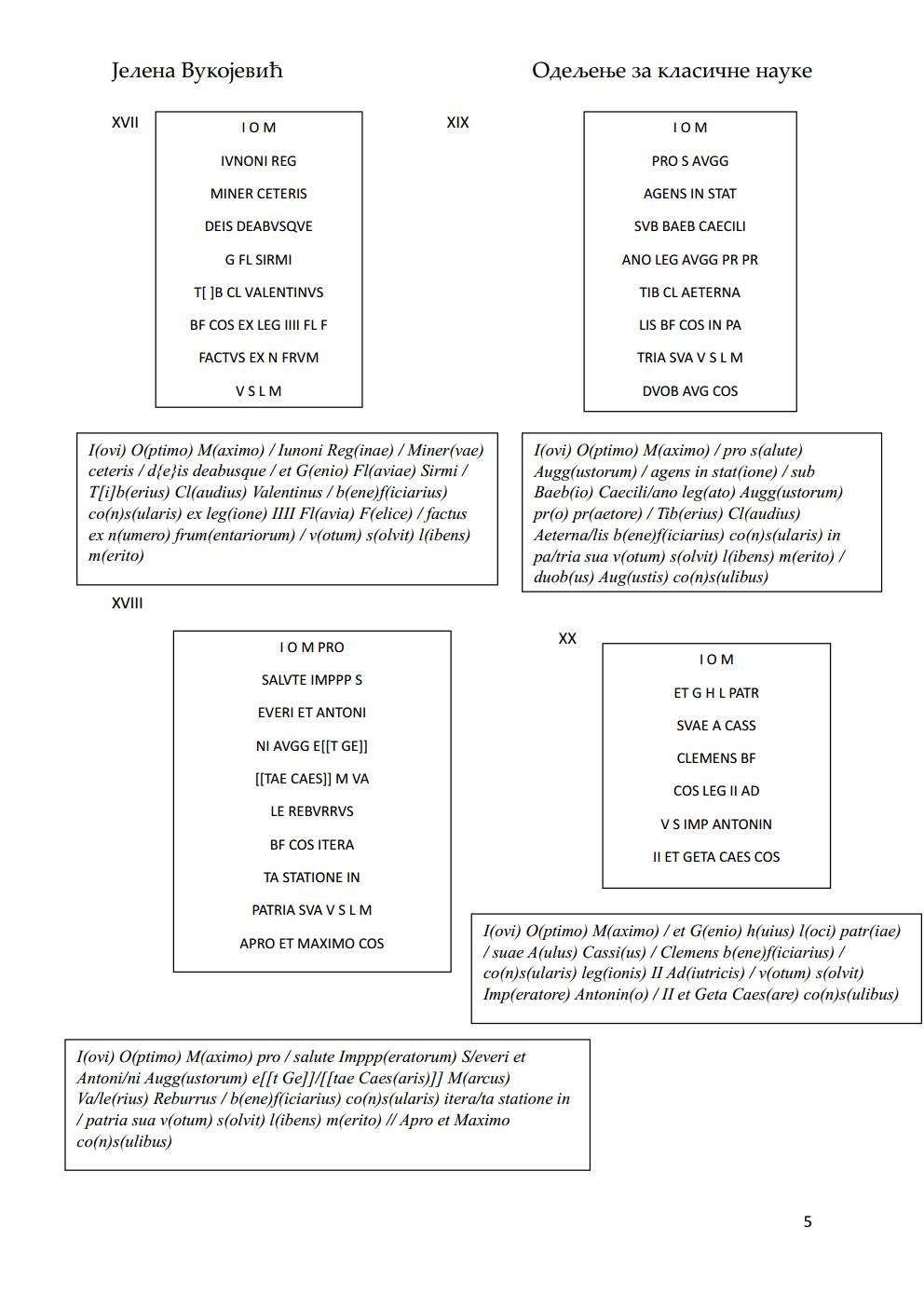
The Stone by Stone activity offers students an engaging way to apply their classroom knowledge through play while working directly with real inscriptions. In this activity, students are challenged to solve a sequence of tasks step by step, using information found on the inscriptions.
Students should be divided into groups (for example, four members per group) and given their first task. All groups begin with the same initial task and receive the next one only after successfully completing the previous step—either by writing down the answer or by pointing it out directly on the inscription. The goal is for each group to complete every step of the challenge successfully. The tasks may require students to identify ligatures, formulas, abbreviations, date expressions, and other linguistic or epigraphic features. To make it easier to track each group’s progress, it is recommended that the task cards for different groups be printed in different colours.
The materials provided in the appendix contain tasks written in Latin, though they may also be adapted for use in the students’ native language.
Jelena Vukojević