South-Eastern Europe in the period of the Roman principate (I-III c. AD) - PART 1
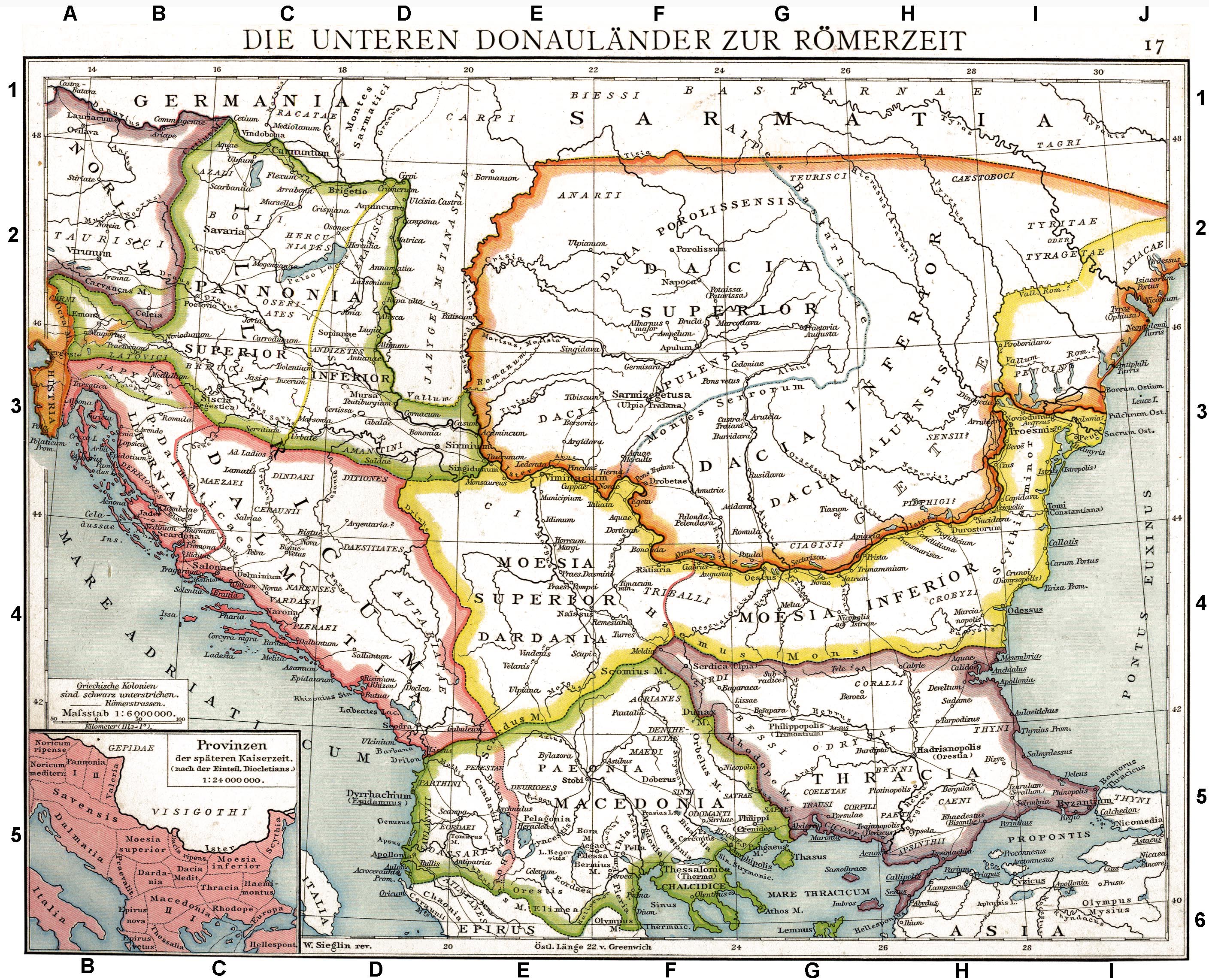
Formation of the Province
The time that can be marked as the beginning of the Roman period in Macedonia is 168 BC. With the Battle of Pydna, the Third Macedonian–Roman War ended, when the Macedonian king Perseus was defeated by the Roman consul Aemilius Paulus. This event ranks among the decisive moments in ancient history, not only for Macedonia but also for the other Balkan states and it certainly became an important precondition for later developments in the Roman Empire, primarily because the Romans finally succeeded in opening the way for the conquest of the East.
Upon the arrival of this news in Rome, Livy, our most detailed source for the events of that year, begins his Book XLV (Liv. XLV, 1, 6–11) with the following description: “It is said that on the fifteenth day before the Kalends of October, on the second day of the Roman Games, a messenger, who claimed to come from Macedonia, handed a wreath-crowned letter to the consul Gaius Licinius, who was seated on the chariot that was about to start. The consul, after the chariots began their circuit, mounted his own and, as he turned along the course toward the spectators, displayed the wreathed tablets to the people. When they saw them, the crowd, forgetting the spectacle, immediately rushed to the center of the arena. At that same place, the consul summoned the Senate and, after reading the tablets, in accordance with the authority of the ancestors, publicly announced to the people that his colleague Lucius Aemilius had fought a decisive battle with King Perseus, that the king had fled with a few companions, and that all the cities of Macedonia had come under the rule of the Roman people. When these words were heard, a great cheer arose with tremendous applause; many people left the games and hurried home to bring the joyful news to their wives and children. It was the thirteenth day since the battle had been fought in Macedonia.”
The following year, the Romans introduced their own system of organization and administration, which implied that the conquered peoples would be granted a fictitious freedom (Liv. XLV, 18, 1–2). In other words, they were allowed to govern their own cities, retain the same city territories, keep their own laws and annual magistrates, while paying to the Roman people half of the tax they had previously paid to the king (Liv. XLV, 29, 4). The cities were the basic units of administrative organization, and the Romans did not interfere in their internal affairs. Moreover, the well-known and time-proven Roman maxim “Divide et impera!” (“Divide and rule!”) proved to be highly effective here as well. The Romans divided Macedonia into four regions (merides) and succeeded in disuniting the fabric of the former kingdom, since communication between the merides was restricted. Aemilius Paulus forbade marriages, land trade, and construction transactions between the inhabitants of different merides; he also prohibited the exploitation of gold and silver mines, while allowing the use of iron and copper resources. The tax was very cleverly reduced to half of the amount previously paid to the king (Liv. XLV, 29, 10–11). Four concilia (councils) were created, one for each meris, along with a synedrion, in which representatives from all merides participated. This body was responsible for mediating relations between Rome and the province, collecting taxes, handling legal matters, dealing with violations of trade laws, and other administrative issues.
That is how the once powerful Macedonian state appeared from a political perspective in 167 BC. The system of governance established by Aemilius Paulus did not prove easy to accept, as rebellions frequently broke out. However, the uprising of the Pseudo-Philippos (Andriscus) in 149 BC was a turning point for the subsequent history of this region. After the suppression of the revolt, the population was fully taxed, and the illusion of freedom was abolished. From 148 BC, Macedonia was organized as the first Roman province on the Balkans, which meant that it received a Roman governor with his administrative apparatus, and a Roman military garrison was stationed there. As part of the Roman Empire, Macedonia became a starting point for Roman campaigns toward other parts of the Balkans and Asia Minor.
Administrative Organization
In 148 BC, Macedonia was organized as a Roman province, and in its administrative functioning, no major changes were made compared to the arrangement established in 167 BC. The province was governed by a Roman governor, a position initially held, for the first two years, by Quintus Caecilius Metellus, who, after defeating Andriscus, was tasked with restoring order in Macedonia and organizing it as a province. Metellus held the position of praetor with proconsular authority (praetor pro consule, στρατηγὸς ἀνθύπατος). If any of the governors died before the end of their term, they were replaced by a quaestor with praetorian authority (quaestor pro praetore, ταμίας καὶ ἀντιστράτηγος). This arrangement remained in effect until the time of Sulla, when, under the Lex Cornelia de provinciis ordinandis in 81 BC, it was decreed that the Senate would choose a former consul with a one-year mandate. This was later changed by the Lex Iulia de provinciis in 46 BC, which maintained a one-year term for praetorian governors but extended the consular term to two years. In 27 BC, the provinces were divided in terms of jurisdiction between Caesar and the Senate, meaning a distinction was made regarding who appointed the governor of each province. Macedonia was classified among the Senatorial provinces, as it was considered pacified, whereas Caesar was assigned the frontier provinces where military unrest persisted. Between 15 and 44 AD, Macedonia and Achaia were transferred into the group of imperial provinces, and later, during the reign of Emperor Claudius, they were returned to the Senate’s administration.
During the Republican period and the Principate, many Romans (negotiatores) settled in cities throughout the provinces, mostly merchants who established themselves in various towns across the Empire and managed to amass wealth in a short time. In Greek inscriptions, they are attested as οἱ συνπραγματευόμενοι Ῥωμαῖοι and were organized into conventus civium Romanorum. Toward the end of the Republican period and after the First Civil War, Rome began founding colonies in the eastern Mediterranean. At that time, the first negotiatores, members of the senatorial order or wealthy equites from Italian cities, started transferring their business activities to eastern urban centers. They entered the local aristocracy through their clients, often freedmen, who acted as intermediaries. Together with the provincial governor and his administration, these negotiatores undoubtedly played an important role in shaping the new urban aristocracy, not only during the early stages of Roman rule in Macedonia but also later on. Conventi and groups of οἱ συνπραγματευόμενοι Ῥωμαῖοι have been documented in Beroea, Acanthus, Styberra, the city at Isar-Marvinci (near Valandovo), Edessa, and Thessalonica.
The division of Macedonia into four merides remained in effect even after 148 BC, and the Macedonian governing institutions included the synedrion, which coordinated affairs among the four merides and their relations with Rome – an arrangement first established in 167 BC. In 148 BC, the Macedonian koinon (τὸ κοινὸν τῶν Μακεδόνων) was also founded, whose members were called Macedoniarchs, and its seat was in the city of Beroea. It is likely that, following the example of the Macedonians, the Romans also established provincial κοινά in other eastern provinces. These bodies were responsible for maintaining the imperial cult and organizing festivals held in honor of the emperor.
The local city laws, that is, the handling of matters related to municipal governance, remained in the hands of the city authorities, just as they had been before the arrival of the Romans. These included the assembly (ἐκκλησία, δῆμος), the city council (βουλή) and the magistrates (ἄρχοντες, ἀγορανόμοι, πολιτάρχαι). The cities also had a gymnasiarch (γυμνασιάρχης), who oversaw the gymnasium, an institution regarded as a central educational and cultural establishment in every city. Sometimes, a patron (πάτρων), usually a Roman of high social rank, acted as a protector of the city, while benefactors (εὐεργέται) contributed to public works and civic life through their generosity. In each city there were also high priests (ἀρχιερεύς, ἀρχιερεία), who were members of the local aristocracy and were elected for a one-year term by the city council.
The population of both cities (πόλεις) and villages (κῶμαι) was divided into tribes (φῦλαι), as attested by the inscription from Bela Crkva and by the inscriptions on the theater seats in Stobi.
Borders
The borders of the province of Macedonia are only partially described in literary sources, while some information comes from epigraphic monuments. During the Republican period, and up until the mid-1st century AD, the borders frequently changed, as Macedonia was the first Roman province on the Balkans, and all newly conquered territories were temporarily attached to it.
With the formation of the province, the southern Illyrian regions were annexed to Macedonia in order to strengthen the link between the province and Italy. The southern border is the least mentioned in ancient sources. From 148 to 146 BC, Achaea was within Macedonia’s borders. The border with Thessaly also changed over time, though it is not known exactly when.
The northern border underwent the most changes. The ethnic frontier of Macedonia was shifted northward or southward because of frequent incursions by northern tribes or defensive campaigns led by Roman governors. In 29–28 BC, Marcus Crassus, in two campaigns, subdued the Maedi, Sardi, Moesi, Triballi, and Dardanians, extending the border northward to the Danube. In 16 BC, the Romans conquered the Dentheletae, and the following year, during the Pannonian wars, Tiberius subdued the Scordisci. In the early 1st century AD, the Romans established the province of Moesia as a military district, incorporating Dardania into it, so Macedonia regained its former northern ethnic boundary, which remained in place until Late Antiquity. In 44–46 AD, the province of Thrace was organized, and the Maedi, Dentheletae, and Bessi were joined to it.
According to Strabo, the eastern ethnic boundary of Macedonia was the Strymon River, which, since the time of Philip II, had shifted to the Nestos River and probably remained there until the 2nd–3rd centuries AD, when the administrative border followed the course of the Strymon River between the Kresna and Rupel gorges, passing along the southern slopes of Mount Orbelos (modern Pirin) and then turning toward the lower course of the Nestos River.
During the late imperial period, Macedonia once again underwent territorial changes. It is believed that around 297 CE, Thessaly and New Epirus (Epirus Nova) were detached from Macedonia, thus creating two new provinces. Under Diocletian, a separate province of Thessaly existed, incorporating the southern and southwestern regions of Macedonia. Evidence for New Epirus comes from an inscription from Ohrid, which mentions Sofronius vir perfectissimus [pra]es(es) prov(inciae) nova[e E]piri, dated between 351 and 354 AD. However, more recent historical research suggests that both provinces, Thessaly and New Epirus, were actually established during the reign of Galerius, after 299 AD, in the early 4th century, as a result of the emperor’s growing military and political ambitions, Macedonia held strategic importance for him and also because of his strong influence over Emperor Diocletian. An inscription from Bargala, dated to 371 AD, defines the northeastern border, indicating that the city at that time belonged to Dacia Mediterranea.
By the end of the 4th century, Macedonia was again divided into two provinces: Macedonia Prima, referring to Macedonia in the narrower sense, territories corresponding to the older, traditional core of the region, and Macedonia Salutaris.
The Macedonian Era
Before the Roman conquest, the Macedonians counted time according to the reigns of their kings. When Macedonia became a Roman province, they changed their method of reckoning years and introduced a new system, known as the Macedonian era. Years were written using letters, usually marked with a horizontal line above them. To convert these dates into the modern calendar, one must subtract 148 from the year inscribed on the monument. See here and here.
Slavica Babamova
Further reading:
(continues)
South-Eastern Europe in the period of the Roman principate (I-III c. AD) - PART 2