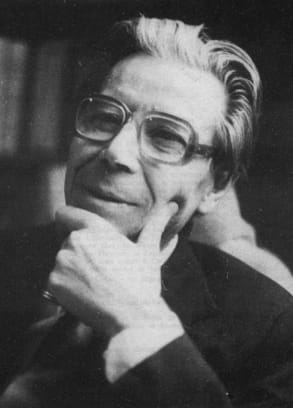
Balkan Legends of Epigraphy: Georgi Mihaylov
 Today we’d like to tell you the story of the renowned Bulgarian epigraphist Georgi Mihaylov.
  Born in 1915 in Sliven, he graduated from high school in Sofia and then enrolled in Classical Philology at the University of Sofia "St. Kliment Ohridski." He went on to specialise at the Sorbonne in Paris, which allowed him to become one of the world's foremost specialists in ancient Greek epigraphy. In Bulgaria, he first worked as a curator of the ancient department at the National Archaeological Museum. Still, he soon returned as a lecturer in the Department of Classical Philology at the University of Sofia, where he gradually rose through the university's cursus honoris and continued to work as an honorary professor even after his retirement. Between 1947 and 1949, he specialised again in Paris. One of his notable teachers was Louis Robert, one of the most rigorous critics among epigraphists and one of the most accomplished Hellenists of the 20th century, who did not withhold his praise for Mihaylov.
 Among Georgi Mihaylov's diverse scholarly activities, Greek epigraphy holds the most significant place. His interest in this discipline was sparked during his student years when he presented his work on The Language of the Greek Inscriptions in Bulgaria. It was subsequently supplemented, revised, and refined for over half a century, only to become his most important work: The Greek Inscriptions Found in Bulgaria, a corpus containing more than 4000 inscriptions in five volumes— deciphered, richly documented, and commented on by the author. It brought him wide international recognition, including the crown of the French Academy in 1957. Georgi Mihaylov was a foreign member of the French Academy of Sciences and the English Royal Society. Among his most remarkable contributions to the epigraphic community was the initiation of the International Association of Greek and Latin Epigraphy. He was elected as its President and remained such until the end of his life.